


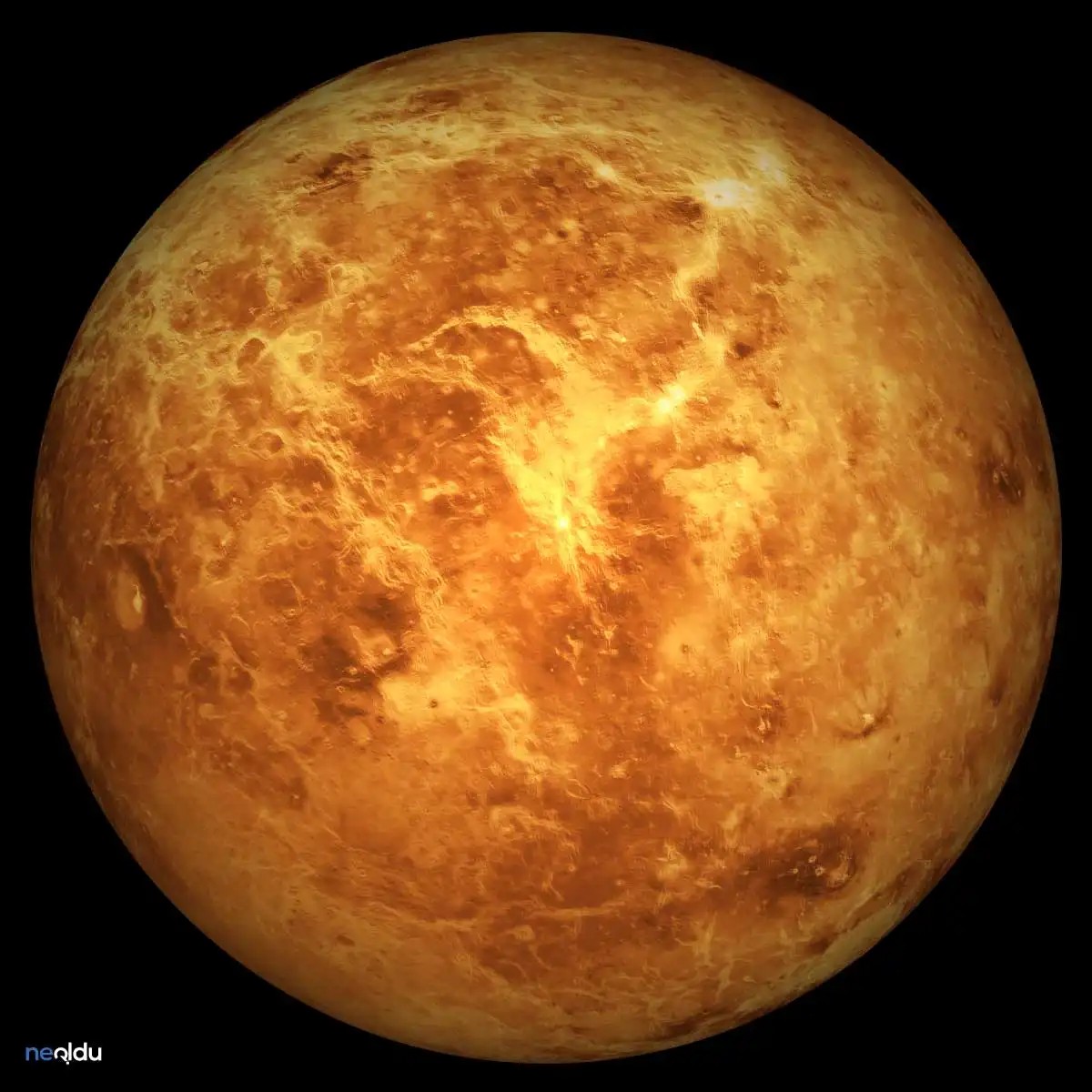
It was there in the twilight, a stubborn point of bright light that the sun refused to extinguish. Most people know it as the evening star or the morning star, depending on when you look up. But beneath this deceptive light lies a world more akin to a caustic cautionary tale than a celestial neighbor. Venus is the second planet from the Sun, then the closest planet in terms of physical proximity. Yes, the Moon is closer, but on average Venus spends more time near us than any other planet.
Named after the Roman goddess of love and beauty, the irony is almost obvious. This planet is a picture of hell. It’s the hottest planet in the solar system, hot enough to melt lead, and the runaway greenhouse effect is so powerful it’s robbing us of liquid water and all hope for life. But for centuries people have only perceived brightness. They looked into the mirror of the earth, a double in size and mass, and imagined a world of ocean and sky. they are wrong.
The Case of the Missing Moon
One of the most remarkable features of Venus is that it has no moons. Earth has a moon, Mars has two small asteroids, but Venus is alone. Spins independently. This is not just a strange phenomenon. It affects everything related to the Earth’s rhythms. Without a moon to stabilize its tilt or influence its tides, Venus is a chaotic system in slow motion. Its rotation is retrograde, meaning it rotates in the opposite direction to most other planets. You can watch the sun rise from the west and set from the east. Days are longer than a year. It takes 243 Earth days to complete one revolution, but only 225 Earth days to complete one orbit around the Sun. This means that a day on Venus is longer than a year. Its mechanics are completely confusing.
The Crushing Atmosphere
Venus has a very thick atmosphere. Crowded. The pressure at the surface is 92 times greater than the pressure at sea level. Imagine diving into the depths of the ocean. However, you are not in the water, you are in the air. It is the surface of Venus. The atmosphere consists mainly of carbon dioxide, and there are clouds of sulfuric acid circling the globe. These clouds reflect sunlight so effectively that Venus is the brightest natural object in the sky after the moon. But that brightness is a mask. There is no sunlight below. There is no blue sky. It is a persistent yellowish mist that absorbs heat with amazing efficiency.
The Surface Beneath the Clouds
Astronomers have long tried to peer into the clouds with the help of radio telescopes. They can see the rotation of the planet and understand its shape, but the surface remains hidden. It wasn’t until the Soviet Union’s Venus probes took real pictures in the 1970s and 1980s. They found a landscape of volcanic plains, plains and mountain ranges. There is no sea. Erosion does not occur because the rain evaporates before it hits the ground. The surface is dry and hot, and the wind blows slowly, but surprisingly weak due to the density of the air. But the pressure is still high. human suit would
Venus has a special reputation. It is the second brightest object in the sky after the Sun, and is usually the only object visible to the naked eye at dusk. It is also the second closest planet to Earth. Thick clouds cover the ground and emit an eerie light day and night. This size is very familiar. With a radius of about 12,104 kilometers, it is almost a twin of Earth.
But if you look closely, the similarities disappear.
Metaphorically speaking, the first thing that hits you is the heat. Venus burns because it orbits so close to the sun. The surface temperature can rise up to 470°C. It is hot enough to melt lead. It is not just warm. It is the hottest planet in the entire solar system. The surface is a landscape of volcanic peaks and fissured plains, baked by enough pressure to crush a submarine like a soda can.
The real story is in the atmosphere. It is full of dense carbon dioxide. This creates a runaway greenhouse effect that traps heat with amazing efficiency. Add clouds of sulfuric acid and hydrogen fluoride, and you get a chemically harsh environment.
Then there is the motion. The earth rotates to the east. Venus rotates in the opposite direction. It rotates westward. This backward rotation is one of the few that really sets it apart. This planet does the opposite in almost every important way.
Orbital mechanics and modes of rotation
The orbit is tight. Venus orbits the Sun every 225 Earth days. However, the rotation speed is very slow. One day on Venus (the time it takes to spin once on its axis) takes about 243 Earth days. It is slower than its year. This means that the sun rises in the west and sets in the east, a confusing fact that emphasizes how strange this world is.
Why is it spinning backwards? Leading theories include a massive collision early in its history, or perhaps a gravitational interaction with the Sun that reversed its tilt over time. In everyday life, where heat and pressure dominate, this is not a problem. The most important thing is the result. Although plate tectonics is geologically active, it is eerily silent. There is no sea. There is no water. Only rock, metal and the sky like a bruised peach.
Scientists have long wondered what lies beneath this cloud. Recent radar imagery shows vast plains, highlands and thousands of volcanoes. Some are dormant. Others may still be active. The surface changes slowly. Without water to erode the landscape, it would remain frozen for millions of years.
The atmosphere itself is a dynamic beast. The wind speed in the upper layers of the clouds can reach 360 kilometers per hour and circle the globe in a few days. This is super-rotation. The atmosphere rotates much faster than the solid surface beneath it. This is a fluid dance of gas and heat caused by intense solar heating at the equator and cooling at the poles.
This extreme environment makes Venus a cautionary tale. This is a world that will get dramatically worse when the greenhouse effect kicks in.
Venus is 108 million kilometers from the Sun and inside Earth’s orbit. Its elliptical path takes about 225 Earth days. But the real story isn’t the orbit. This is rotation. And it’s backwards.
Venus rotates in the opposite direction to most planets. Spinning is also very slow. One day on Venus is equivalent to 243 days on Earth. 1 year? Only 225 days. So a day is longer. Strange? Yes. Is it ineffective? completely. This slow rotation has significant downstream effects. It kills the magnetic field.
The absence of a strong magnetic field means that there is no protection from the solar wind. That’s bad. It actually helps create a pressure cooker effect. The atmosphere is stuffy. Its density is 90 times that of Earth. It is mostly carbon dioxide.
Composition of a Hellscape
The air you breathe there is not only difficult to breathe. It’s toxic soup. The Sulfuric acid clouds dominate the upper layers. These clouds reflect a lot of sunlight, keeping Venus bright. But they also trap heat.
Surface temperatures hover around 465 degrees Celsius (870 degrees Fahrenheit). Hot enough to melt lead. This isn’t just a warm day. This is a runaway greenhouse effect. Carbon dioxide traps infrared radiation. Heat gets in. Stays in. Builds up.
Why is this important? Earth’s climate models often use Venus as a warning. This shows what will happen if the accumulation of greenhouse gases is not controlled. We’re not exactly on the same path. But the physics are similar. Carbon dioxide absorbs heat. Carbon dioxide increases. More heat. This cycle is self-reinforcing.
Pressure and mystery
The atmospheric pressure on Venus is about 92 bars. This is equivalent to about a kilometer deep in the Earth’s oceans. If you stand on the ground (instant death), its weight will crush you.
High pressure also raises the boiling point of sulfuric acid. That’s why it doesn’t rain right away and clouds form in the sky. Chemical processes are complex. Volcanic activity can increase the sulfur content. But we don’t know. We have only scratched the surface.
During the Soviet Venus program in the 1970s and 1980s, the robotic landers survived only a few hours. They sent back a blurry, sepia-toned images. Rocky terrain. flat plains. some hills. However, the landers dissolved quickly. The environment is too harsh, so it is too hostile for long-term study.
Why we keep looking
You may be wondering why we are going through all this trouble. Very expensive. This is dangerous. The payoff seems small. However, Venus hides clues about the evolution of the planet. It is roughly the same size and mass as Earth. But it’s still hell. How did they differ?
Is it the distance from the sun? The greenhouse effect triggers? A different volcanic history? These questions guide missions such as NASA’s DAVINCI+ and ESA’s Envisat. We want to measure the atmosphere in detail. We want to know if Venus ever had water. If so, where did it go?
Sulfuric acid clouds are a mystery. They suggest that atmospheric chemistry is active. But we don’t know the source. Yes
Venus is one of the hottest planets in the solar system, not because of its proximity to the sun, but because of the composition of its air. The atmosphere is a dense layer of carbon dioxide, which makes up about 96% of the mixture. This is in stark contrast to Earth’s thin air, which supports life.
As a result, the greenhouse effect is runaway. The trapped heat raises the surface temperature to 465 °C. Hot enough to melt lead. Hot enough to keep you oppressively warm all the time.
The Cloud Cover That Hides the Surface
If you look at Venus from space, you’ll see a uniform, pale yellow sphere. It is thick. It is very thick. It is very heavy. The clouds are primarily sulfuric acid droplets mixed with water vapor. They act like a mirror and reflect most of the sunlight back into space before it can ever hit the ground.
This opacity has puzzled astronomers for centuries. Optical telescopes cannot see surface details. The clouds are so thick that even the most powerful lenses on Earth cannot penetrate them. We had to wait for radar technology maps what lies beneath the surface. The surface is hidden in eternal twilight, illuminated only by the faint glow of incandescent rock and dim, filtered sunlight.
Winds That Defy Logic
Then there is the wind. On Venus, the movement of the atmosphere is independent of the planet’s rotation. Venus rotates very slowly, taking 243 Earth days to complete one revolution. However, it only takes four days for the atmosphere to circle the Earth. This phenomenon is known as super-rotation.
The winds at the top of the cloud layer can reach speeds of around 360 kilometers per hour. That is roughly 60 times faster than the fastest wind speed ever measured on Earth. They are not just fast; They are chaotic. Because the surface rotates so slowly that it cannot influence the upper atmospheric currents. Winds blow in different directions at different latitudes, creating a turbulent, churning sky that are nothing like the winds we experience here.
Layers of Pressure and Heat
The structure of the atmosphere is not uniform. It is layered like an onion, but the pressure and temperature with extreme variations in pressure and temperature. From top to bottom, it breaks down into distinct zones:
- The exosphere is the outermost layer that fading gradually into the vacuum of space.
- Below is the mesosphere, where the temperature starts to drop as you descend.
-The stratosphere is located below the cloud tops and is characterized by a temperature inversion.
-The troposphere makes up most of the atmosphere. Here, the pressure is crushing— about 92 times the sea level pressure on Earth, and the heat is intense.
Each layer has its own chemical signature and physical properties. For example, the troposphere is where weather occurs, where sulfuric acid rain falls (although sulfuric acid rain evaporates before it reaches the ground), and where super-rotating winds dominate. Understanding these layers is key to understanding why Venus is the way it is.
Venus’s Surface
Known as the hottest planet in the solar system, Venus’s atmosphere is so thick that it feels like it is being crushed by deep water. Its surface is forever hidden behind thick clouds, so we can’t just look up and see what’s below. But radar mapping and orbital data confirm that the ground is anything but flat. It is full of fissures, towering mountains and active volcanoes.
The geology here is deceptive. Superficially, it mimics the Earth. The mountains and rift valleys we see show tectonic activity, but the mechanisms are fundamentally different. The Earth’s crust splits into plates that rub against each other, causing earthquakes and forming new ocean floors. Venus does not have such plate tectonics. Instead, it acts as one giant tile. The crust moves, stretches and breaks apart as a whole, but there are no subduction zones as we know them.
Maxwell Montes: Roof of the World
When you’re looking for the highest point on Venus, you’re not looking for jagged peaks, you’re looking for Maxwell Montes. This mountain range stretches for about 8,000 miles (13,000 km) and is about 4 miles (7 km) high. It is the planet’s definitive summit, rising above the surrounding plains.
Maat Mons is closely related to this highland topography. It is located about 5,000 meters above sea level and is one of the largest volcanoes in the entire solar system. While there are giant volcanoes on Earth like Mauna Loa, Maat Mons is a unique beast shaped by a different kind of volcanic history.
The peculiarity of the craters of Venus
If you landed on Venus, the craters you’d find wouldn’t look like the mottled scars of Mercury or the Moon. They are rougher. Purer. It doesn’t have the nice bowl-like symmetry you see elsewhere.
Why? atmosphere. The air on Venus is thick enough to act as a shield, but not thick enough to stop everything. The interaction between the incoming asteroid and the dense acid cloud may have distorted the impact, creating these irregular, porous structures before the debris even hits the ground.
Lava and Plains: Volcano World
But the most striking feature of Venus has none its mountains. This is lava.
Volcanic activity on Venus is slow. It does not explode with the explosive violence that is common on Earth. Instead, it leaks out. Huge rivers of lava crawl across the surface, cooling to form vast plains that cover about 80% of the globe. These are not small streams. We’re talking about continent-sized basalt slabs that have resurfaced the entire globe multiple times throughout history.
This raises pressing questions for planetary scientists. Where does the heat go when the surface is so young and covered by recent lava flows? On Earth, plate tectonics acts like a thermostat, releasing internal heat through the subduction and spreading of ocean ridges. Venus has no such valve. It traps heat. As a result, the planet periodically bakes itself, melts its crust and starts its cycle again.
Satellites of Venus
There is also the issue of satellites. Unlike Earth, Mars and even the gas giants, Venus has none. There is no moon.
Why doesn’t Venus have satellites?
It seems counterintuitive that a planet roughly the size of Earth could exist on its own. However, Venus orbits the Sun in complete isolation. There are no natural satellites. Not one rock circles the red-hot planet.
The reason is gravity. Or rather, it is lacking in this particular situation. Venus does not have the massive gravity needed to capture passing asteroids or sustain small moons for billions of years. Gravity is strong, yes. However, it is not powerful enough to snatch a neighbor and lock it into a stable orbit.
This absence separates Venus from its siblings. Look at the inner planets. Earth has a moon. Mars has two small, irregular moons. Mercury has none. But what about Venus? It is the only major inner planet that is completely moonless.
It is also not orbited by satellites. There are no spaceships in orbit. No rovers looking up at the empty night sky. Any mission that touches Venus’s atmosphere plunges directly into the destructive pressures below. The silence of its orbit is total.
Orbital neighbor
When talking about proximity to our home planet, Venus comes in second. It is the second closest planet in the solar system to Earth. Strictly speaking, Mercury is closer to the Sun, but Venus often moves closer to us in its orbital dance.
This closiness makes it a frequent target for observation. It is the second brightest object in the night sky after the moon. A sharp, white dot that refuses to set. But this proximity also makes it a dangerous neighbor. Its orbit is very close to Earth, creating a gravitational tug of war that has shaped both of our worlds for eons.
Surface: volcanic hellscape
If you could stand on Venus, you wouldn’t see what you expected. The surface is not a barren desert like Mars. It is a active, volcanic landscape. Lava flows have reshaped the planet repeatedly. Craters are scattered, but fewer than expected, indicating that the surface is relatively recent and gets resurfaced periodically.
But you’d never see any of it. You can’t see it with your eyes. The thick blanket of clouds blocks all visible light. It is a perpetual, thick fog. Radar is the only way to map the terrain. The data revealed a world of highlands, lowlands and vast volcanic plains. Atmospheric pressure is 90 times that of Earth. It’s easy to get overwhelmed. The heat will boil you before you hit the ground.
The Atmosphere: A Greenhouse Catastrophe
The air around Venus is thick. Full of carbon dioxide. This isn’t just a little greenhouse effect. It is a runaway one. The sun’s heat comes in and tries to go out. The atmosphere traps it and stacking heat on top of heat.
result? Venus is the hottest planet in the solar system. Hotter than Mercury, which is much closer to the Sun. The temperature reaches about 460 degrees Celsius. It is hot enough to melt lead. The atmosphere is so dense and feels like you are under water. But instead of water, you breathe in a cloud of acid.
Could there be life there?
Forget it. The conditions are hostile beyond comprehension. Temperatures are consistent and extreme. The pressure is crushing. The atmosphere is corrosive. There is no liquid water on the surface. No shelter from


