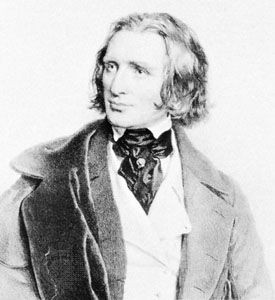
Franz Liszt was more than just a composer. He was a phenomenon. Ferenc Liszt was born on October 22, 1811 in Raiding, Hungary and grew up to become one of history’s most important pianists and musical innovators. His father was a really talented amateur musician and noticed his son’s talent from an early age. The young Liszt had already started composing at the age of eight.
He didn’t learn in a vacuum.
In Vienna, he studied piano under Karl Czerny and composition under Antonio Salieri.
This rigorous training quickly paid off. In 1822, he made his first public appearance.
In 1823 he arrived in Paris and was successful. Then came the tours. He traveled across Europe, but the path was not smooth. In 1828 his father died. A disastrous love affair left him heartbroken because of a tragic love affair.
At one point, he really wanted to quit music and become a priest.
Then came 1831.
Everything changed when he heard the violinist Niccolo Paganini. Liszt saw all the possibilities. He pushed his skills to the absolute limit. He started working on his first mature works. This period produced Transcendental Études (1837) and Paganini Études (1839).
His personal life was as dramatic as his music. He had an affair with Countess Marie d’Agoult. They had a daughter Cosima born in 1837. She later married his friend, the composer Richard Wagner.
In the 1840s, Liszt had reached his peak. He traveled around Europe as a virtuoso. Critics and audiences loved him. They loved his talent. They were amazed at his technical abilities. However, he stopped performing in the late 1840s. He wanted to concentrate on composing. He also wanted to support progressive composers.
The 1850s produced some of his most ambitious work. He composed the A Faust Symphony in 1854. In 1853 he composed the piano sonata in B minor. These works show depth beyond mere showmanship.
In 1865, he took minor Roman Catholic church orders from the Roman Catholic Church. Although he never became a full priest, his faith remained at his core. His later works were ahead of their time. He developed chromatic harmony in a way that anticipated atonal music. He influenced the 20th century long before it began.
How Liszt’s techniques redefined piano playing
Why does Liszt still matter? Because he changed what the piano could do. Before him, piano music was often limited to a clear structure. Liszt broke these boundaries. He explored new sounds. He pushed his instrument to its limits.
His influence isn’t just historical. It’s practical. Pianists continue to study his work to understand technique and expression. Transcendental Études is still the standard of mastery. They are difficult. They are rewarding. They show what is possible when technique meets artistry.
The legacy of a Hungarian genius
Liszt died on July 31, 1886 in Bayreuth, Germany.