Batrachochytrium dendrobatidas didn’t ask for permission.
It swept in. It killed.
This fungal pathogen is the worst infectious disease killer in recent ecological history. More extinctions, period. Amphibians are ground zero. Frogs. Salamanders. Toads. If it lands on their skin, the clock starts ticking toward a fatal cardiac arrest. The fungus blocks oxygen intake. They essentially drown on land.
But hold on.
Up in the Pyrenees mountains, things look different.
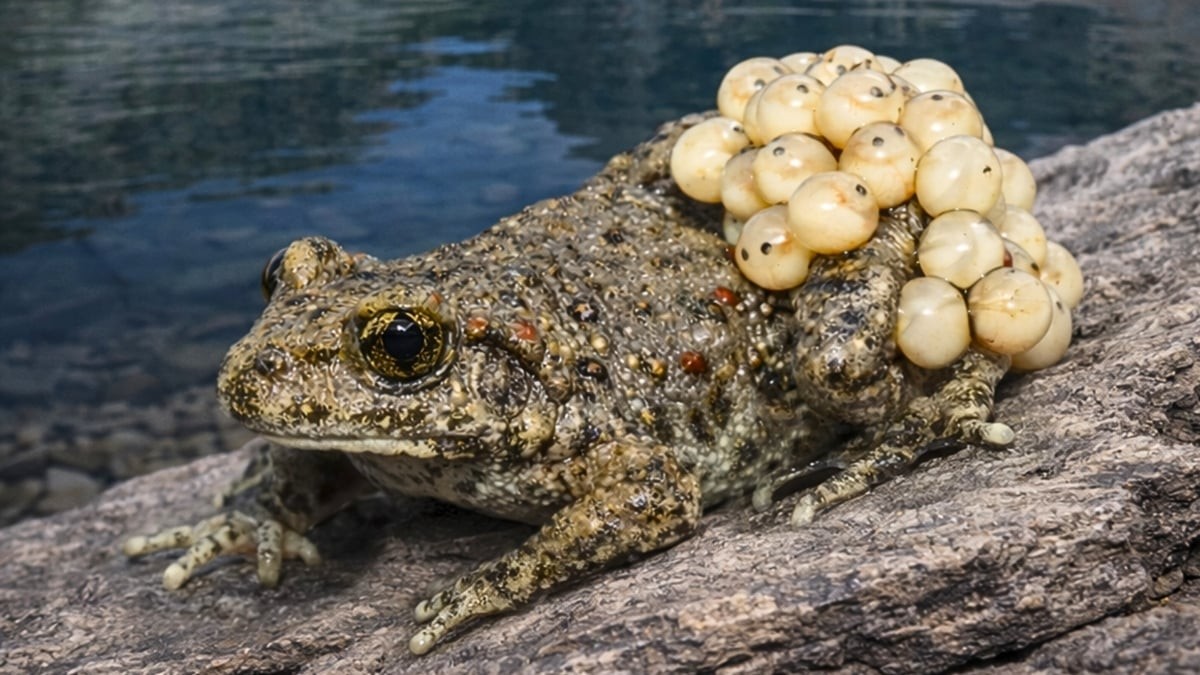
A specific group of midwife toads —Alytes obstetricans —are still breathing. Still moving. Still breeding. While their neighbors at nearby lakes are ghost populations, gone to dust, these survivors are thriving. Specifically in three spots: Ibón de Acherito, Puits d’Arious, and Lac de Lhurs.
Compare them to the victims. Take Lac d’Arlet. Nearly wiped out. The same fungus hit both sets of lakes. Same altitude. Same cold water. Yet one side survives and the other side collapses.
Why?
How Midwife Toads Defeat the Lethal Fungus Early
A research team dug into the difference.
University College London. Zoological Society of London. Imperial College London. They brought their microscopes to the high-altitude lakes. They wanted to know what was happening on a molecular level inside the skin of a survivor versus a victim.
The answer came down to timing.
Antimicrobial peptides are tiny protein chains. Toads secrete them through their skin to kill bacteria and fungi. In the dying populations, the immune system kicks in late. In the surviving populations? It kicks in early. Way early.
The toads start secreting these peptides while they are still tadpoles.
This matters for two reasons. First, tadpoles lack keratin in their skin. Chytrid needs keratin to infect. It can’t hold onto smooth, juvenile skin for long. But second, the transition phase is deadly. Once the legs grow. Once the tail shrinks. Once the keratin arrives. That’s when the door opens for the fungus.
By starting peptide secretion as tadpoles, these midwife toads build a defensive wall before they become vulnerable hosts. They bridge the gap between water-bound innocence and terrestrial exposure.
Carrying protection against the fungus during this vulnerable transition phase could be the difference between extinction and survival.
Philip Jervis, the herpetologist leading the charge from ZSL, notes it isn’t just about the presence of the peptides. It’s about when they appear. He suspects the trigger might be genetic. Or maybe environmental. High temperatures from climate change? Or maybe it’s about pressure from predators. Trout in those lakes eat tadpoles for breakfast. Maybe the trout force the tadpoles to metamorphose faster? If you rush the clock, does the immune system lag behind? That’s the mystery.
What Makes Midwife Toad Peptides Different
There is another layer to this discovery.
Chemist Alethea Tabor’s team expected a modest haul. Maybe a handful of new compounds.
They found 1,152 peptides.
Only seven had been cataloged before. That’s a staggering amount of biological weaponry sitting right on the skin of a toad you might step on near a French mountain stream.
The survivors didn’t just start early. They had diversity. High peptide diversity in the tadpole phase correlated directly with survival through outbreaks. Low diversity? You’re likely dead.
This isn’t just academic trivia about frogs.
Humans are fighting a losing war against antimicrobial resistance. Our drugs are failing. Bacteria and fungi are evolving past our synthetic solutions.
Nature? Nature has been solving this problem for millions of years.
A lot of human medicines came from nature originally—penicillin from fungi being the classic example. These peptides are fresh leads for new antibiotics.
Think about that. A tiny amphibian in the Pyrenees holds clues to next-generation human medicine. While we struggle with hospital superbugs, midwife toads are pumping out effective antimicrobials just by existing.
Climate Change and the Future of Amphibian Refuge
It used to be that the cold kept chytrid at bay.
High-altitude lakes freeze over. Half the year. Chytrid hates the cold. The Pyrenees were a natural quarantine. A frozen sanctuary.
Then we started warming the planet.
Fossil fuels burned. Temperatures rose. The ice shrank. The damp warmth arrived. Chytrid moved in. It spread nineteen years ago across the Western Pyrenees.
Now, only these few pockets remain. Ibón de Acherito stands as a beacon. Why it persists and Lac d’Arlet fell silent is the question that haunts the researchers. Was it luck? A genetic mutation? Or did the presence of trout create an evolutionary arms race that inadvertently built better immune systems?
Phillip Jervis is digging for answers. He wants to know why some immune systems mature early and others don’t. If we can identify the triggers, can we boost the weak? Can we help other frog species elsewhere in the world learn to secrete these peptides sooner?
Maybe.
Maybe not.
The fungus is relentless. It is currently driving species toward extinction faster than we can catalogue them. But here, in the clear waters of the mountains, there is a flicker. A small, green flicker of resistance.
It reminds us that evolution is messy. It’s abrupt. It doesn’t always follow the rules of textbooks. Sometimes survival is just a matter of starting early enough to build the shield before the arrow arrives.
What other secrets are hiding in the slime of threatened species?
We might be overlooking them while looking for bigger answers.
The midwife toad carries its eggs. Protects them. Walks them to water. And now it seems, it carries the keys to its own survival too.