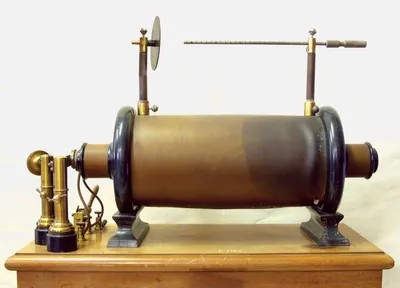
High voltage wasn’t always something you feared behind glass. Before the grid, before the hum of transformers, there was a spark. A literal one. Up to three feet long. It jumped across the air in Parisian workshops, courtesy of a German mechanic named Heinrich Daniel Ruhmkorff.
He didn’t set out to change physics. He just wanted to make better machines.
Born in Hanover in 1803, Ruhmkorff started as an apprentice. He learned the trade the hard way, with grease and gears. Then he went to England. There, he worked with Joseph Bramah. You might not know the name Bramah, but you’ve seen his invention. The hydraulic press. It’s the thing that crushes metal into shapes or lifts heavy loads with fluid power. Ruhmkorff saw how pressure worked. He wondered if electricity could do similar heavy lifting.
Why the Ruhmkorff induction coil mattered
In 1855, Ruhmkorff opened a shop in Paris. This wasn’t a quiet back-alley stall. It became the place to be for anyone needing top-tier electrical apparatus. He built induction coils that were better than anything else on the market.
Here is the core problem he solved: how do you get high voltage from a low-voltage source?
Ruhmkorff’s answer was the Ruhmkorff coil. It used a trick called magnetic induction. He wound wire around an iron core in two distinct layers. The primary winding got a steady, low-voltage current. The secondary winding had thousands more turns of thinner wire. When the current in the primary side was interrupted, the collapsing magnetic field induced a massive spike of voltage in the secondary side.
The result? Sparks. Long, loud, blue-white sparks.
The coil produced sparks more than 30 centimeters long.
That was enough to light Geissler tubes and Crookes tubes. These were early vacuum tubes. They glowed when electricity zapped through the rarefied gas inside. They were toys for scientists, sure. But they were also the ancestors of everything from neon signs to X-rays.
From sparks to the modern grid
Emperor Napoleon III noticed this. In 1858, he handed Ruhmkorff a 50,000-franc prize. That is a lot of money for a mechanic. The prize recognized that this wasn’t just a parlor trick. It was a tool.
The coils were used for detonating devices, too. Electricity could now trigger things remotely and reliably. But the real legacy is quieter.
The double-wound design of the Ruhmkorff coil is the direct ancestor of the alternating-current transformer. Every time you plug a laptop charger into the wall, you are using a device that traces its lineage back to Ruhmkorff’s Paris workshop. He took a chemical battery’s weak push and amplified it into something that could jump across a room.
He died in 1877. The coils kept sparking.
We take voltage conversion for granted now. We flip a switch, the lights come on. We don’t think about the iron cores or the copper windings