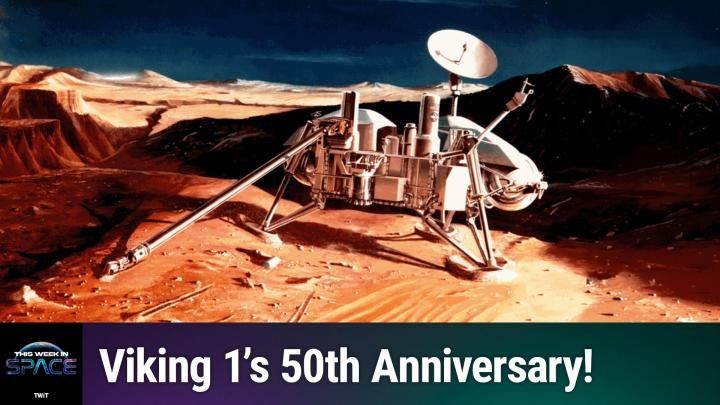
Fifty years ago today. Well. Roughly.
Viking 1 touched down on the rust-red soil of Mars. It was the first US lander to achieve a soft landing on another planet. A milestone.
But here is the thing that keeps astrobiologists up at night.
The data came back. The experiments ran. And the result? It was messy.
Episode 220 of This Week In Space digs into this specific historical knot. Rod Pyle and Tariq Malik bring in the heavy hitters—Dr. Pascal Lee and Dr. Penny Boston. They aren’t just reciting dates. They are dissecting the Viking life detection experiments that produced a paradox no one has fully solved.
Did we find life?
Or did we find chemistry that looked like life?
The Starship delay and the lightning strike
The podcast doesn’t stay stuck in the past. It pivots to the immediate present. Fast.
Starship Flight 13 is hovering on the launch pad. Literally.
SpaceX is fighting a legal battle. A proposed land swap at Starbase in South Texas is blocking progress. Indigenous groups and conservationists are demanding court intervention. The court has to decide now.
Meanwhile, over in China, a Long March 3B rocket got hit by lightning during liftoff.
You’d think that would end the mission. It didn’t. The satellite delivered safely. It’s a stark reminder of the violence inherent in rocketry.
“Lightning strike on Chinese rocket captured in epidemic launch photo.”
Chaotic. Dangerous. Successful.
Why Viking 1’s results are still controversial
Back to Mars. Back to the mystery.
The Viking 1 landing marked the end of an era and the start of a fifty-year argument. The biological experiments showed positive reactions. Gases released. Metabolism-like activity.
But the gas chromatograph mass spectrometer found no organic compounds. No carbon chains. No building blocks.
So, what happened?
The leading theory now points to perchlorates.
These salts exist in the Martian soil. They are oxidizing. When heated during the Viking experiments, they likely destroyed any organics that were there. They also created false positives for life.
It wasn’t biology. It was chemistry mimicking biology.
But is it entirely ruled out? Some scientists still push back. The data is ambiguous. The rivalry between those who see “dead rock” and those who see “potential biosignatures” is fierce.
From Mariner flybys to modern debate
The episode traces the arc. It starts with the Mariner 4 triumph. A single grainy photo. Then Mariner 9, orbiting the planet, revealing canals were myths but volcanoes were real.
Then came Viking.
The landing itself was engineering perfection. The science was… complicated.
This isn’t just about history. It shapes how we design future missions. If you think there might be life, you can’t just heat the soil and see what happens. You have to look closer. Deeper. Without destroying the evidence first.
Want to build your own rocket?
If the Starship launch drama feels too distant, there is a tangible fix.
Estes Industries makes a scale model of a Falcon 9. It isn’t just plastic. It launches.
It retails for $149.
It captures the geometry of the real thing. The fins. The nose cone. The thrust. You can buy it now. Use the code IN-COLLECTSPACE for a 10% discount. CollectSPACE.com is backing this.
It’s a reminder. We can build the dream. In our living rooms.
The open question remains
Fifty years on.
We have rovers. We have orbiters. We have samples coming home.
But we still haven’t answered the question Viking 1 raised.
Are we alone?
The perchlorate explanation is solid. But the ambiguity lingers. It sits in the data. In the soil. In the debate.
Maybe the next mission will clarify it. Or maybe it will just ask