Something is fundamentally wrong with the center of our galaxy.
For decades, astronomers have watched the galactic core glow with gamma rays. This light comes from positrons—antimatter twins of electrons—colliding with ordinary matter and vanishing. The problem? We have no idea where all these positrons come from. Known sources like black holes and neutron stars don’t make nearly enough.
Now, two physicists say they might have found the answer, and it is much worse.
Thomas Siegert and Hiroki Yoneda report detecting the signature of antimatter annihilation outside the Milky Way. Specifically, in gas clouds drifting away from our galactic disk.
“This would be the first detection of extragalagic positron annihilation,” Siegert said. “That in itself would mean the positron content of the Milky Way is much larger than what is currently observed inside.”
Why Can’t We Explain Milky Way Positron Production?
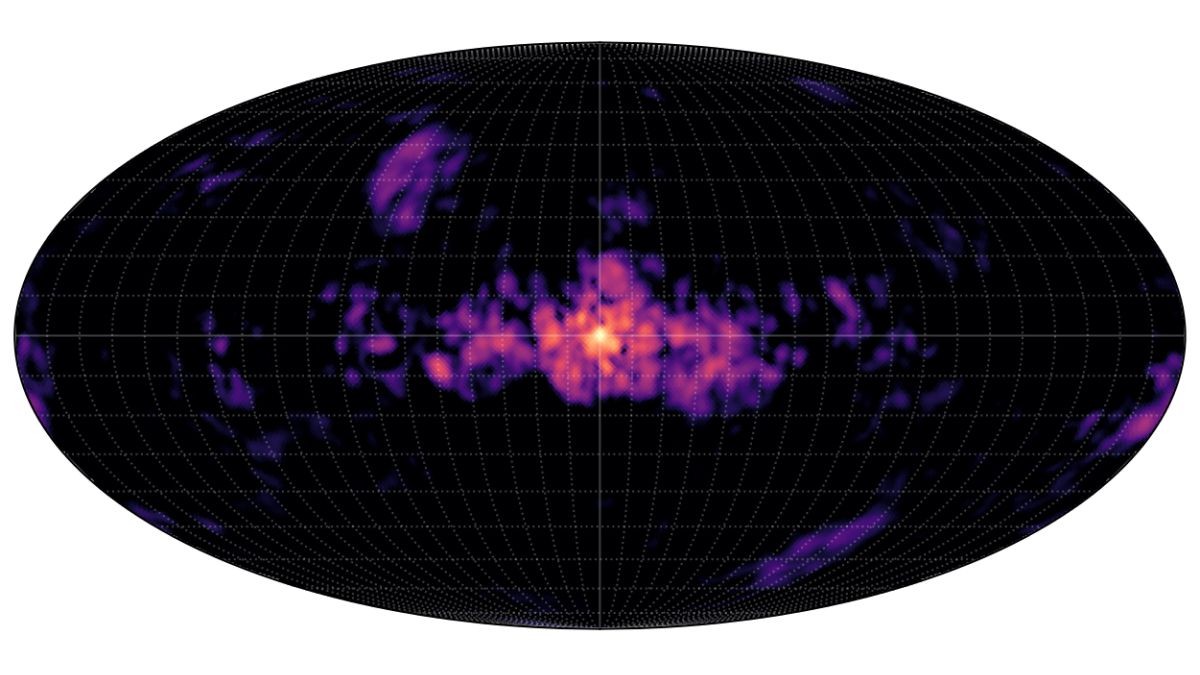
The signal in question is the 511 kiloelectronvolt gamma-ray line. It’s the fingerprint of a positron meeting an electron. They annihilate. Boom. Gamma rays.
Astronomers mapped this across the sky for twenty years using the European Space Agency’s INTEGRAL telescope. The mission ended in 2025, leaving a massive dataset. Siegert and Yoneda dug through it all. They split the data into three-year chunks, then six, then nine. They looked for instrumental errors. Background noise. Glitches.
The signal remained. It grew stronger with time.
So where did they look?
Two specific regions caught their eye:
* Complex C: A massive hydrogen cloud falling toward the Milky Way.
* The Magellanic Stream: A ribbon of gas trailing the Large and Small Magellanic Cloud orbits.
Neither of these places should have positrons. They are far from the energetic sources that create them. This implies the positrons traveled there. They escaped the Milky Way.
Here is the kicker: Positrons need to be slow to annihil efficiently. High-energy ones just fly by. For them to annihilate in distant gas clouds, they must have escaped our galaxy at high speeds, slowed down in the intergalactic medium, and then collided.
That escape mechanism was completely unexpected.
How Much Antimatter Is the Galaxy Actually Producing?
If positrons are leaking out before they annihilate inside the disk, we have been undercounting the total production.
Significantly.
Siegert and Yoneda calculate that the Milky Way pumps out roughly 100 tredecillion (that’s a 14 followed by 14 zeros) positrons every second. This is two to three times higher than previous estimates.
“We are running out of conventional astrophysical objects to explain them,” Siegert noted.
Black holes. Radioactive decay in stars. Neutron stars. None of these add up to the new number. The gap is widening.
Is it possible the data is wrong? Maybe.
The strongest signal hit a statistical confidence of 4 sigma. That means there is about a one-in-15,00 chance it is a fluke. Physics demands 5 sigma for a confirmed discovery. It’s tantalizing, not definitive. But the authors are confident. They see real annihilation signatures beyond our galactic neighborhood.
Could Dark Matter Be the Source of Antimatter?
So what produces this excess?
Conventional astrophysics is struggling. The numbers are too high. The sources don’t fit.
Siegert suggests we might need to look elsewhere. Not at stars, but at the invisible scaffolding of the universe.
“Light dark matter particles,” he proposed.
If dark matter particles annihilate or decay, they could produce positrons. If the new estimate of production is correct, standard dark matter models might need to be tweaked. Or replaced entirely.
NASA plans to launch the Compton Spectrometer and Imager, or COSI, in 2027. This telescope will have better sensitivity than INTEGRAL. It can confirm or deny these “tantalizing hints.”
Until then, we are left with a galaxy that is more antimatter-rich than we thought. Leaking particles into the void.
Where do you think the rest are hiding?