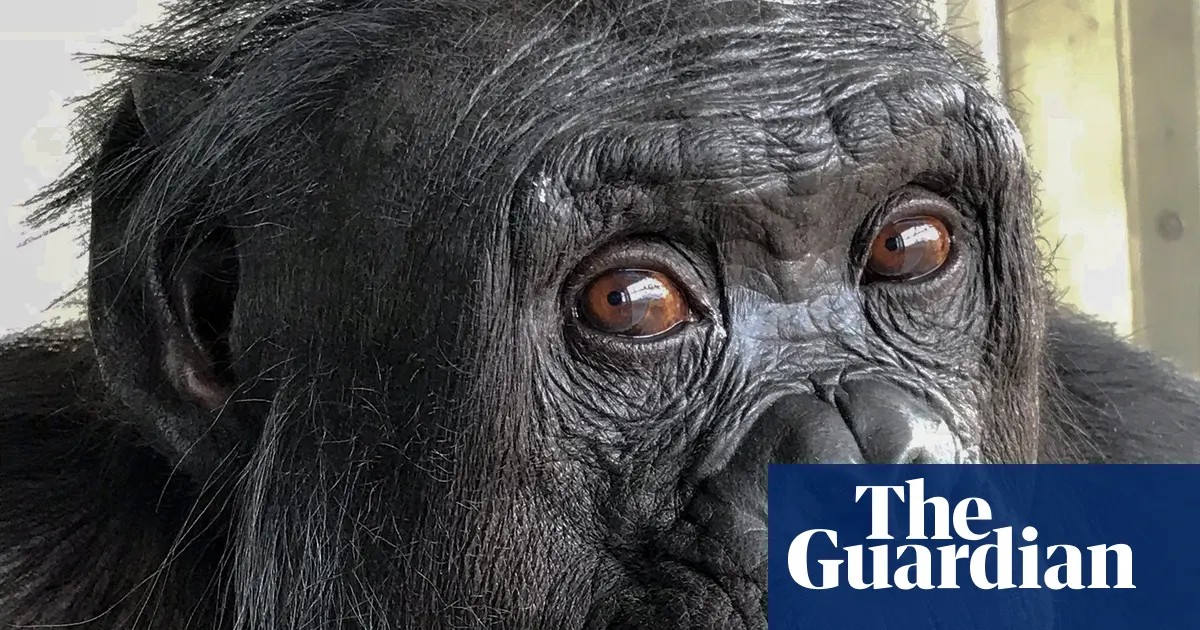
For decades, the line between humans and great apes was drawn with a sharp, definitive stroke. We believed we were the only ones capable of complex imagination, rational thought, and deep social understanding. However, a growing body of scientific research is blurring those lines, revealing that our closest relatives possess mental lives far more sophisticated than we ever imagined.
From “imaginary” tea parties to the rational revision of beliefs, the latest findings suggest that the cognitive gap between humans and apes may be much smaller than previously thought.
The Power of Make-Believe
In a groundbreaking study published in Science, researchers documented something once thought to be uniquely human: pretend play.
At the Ape Initiative facility, a 44-year-old bonobo named Kanzi participated in experiments that tested his ability to engage in “secondary representations”—the ability to envision a reality that isn’t physically present. By interacting with empty pitchers and “invisible” juice, Kanzi demonstrated that he could grasp the concept of a pretend beverage, choosing the “filled” cup even when no liquid was present.
“It seems to be a recurring thing in our field where people come up with reasons why humans are special and unique, and then scientists… find that, actually, maybe we’re not that special after all,” says Amalia Bastos, a comparative psychologist at the University of St Andrews.
Rationality and Social Intelligence
The definition of a “rational animal” has long been a human hallmark, yet recent studies show that chimpanzees are capable of logical deliberation.
- Updating Beliefs: Research conducted at the Ngamba Island sanctuary in Uganda revealed that chimpanzees do not simply stick to their guns; they revise their beliefs when presented with stronger evidence. If a chimp makes a choice based on a weak cue and then sees a more convincing sign, they will change their mind—a hallmark of rational thought.
- Theory of Mind: Scientists are increasingly finding evidence that apes possess a “theory of mind”—the ability to understand that others have their own distinct thoughts, desires, and intentions.
- Long-term Memory: Using eye-tracking technology, researchers found that bonobos and chimpanzees can recognize social partners they haven’t seen in over 25 years, showcasing a profound capacity for long-term social connection.
The Complexity of Wild Cultures
While much of this research happens in controlled environments like zoos or sanctuaries, observations in the wild are revealing even more startling behaviors.
In Indonesia, researchers observed a Sumatran orangutan named Rakus using a specific liana vine to treat a facial wound. The plant’s antibacterial properties helped the wound heal, marking one of the first recorded instances of an animal using plants for active wound healing.
Furthermore, primatologists have noted that great apes possess distinct cultures. Much like human societies, different chimpanzee communities develop their own “languages” and tool-use traditions:
– A specific leaf-biting gesture might signal play in one group but sexual intent in another.
– One community might favor wooden hammers, while another uses stone.
The Conservation Dilemma: Protecting “Cultural Heritage”
These discoveries raise a critical question for the future of conservation. Currently, most efforts focus on preserving species numbers to prevent extinction. However, experts like Professor Kristin Andrews argue that we must also protect cultural diversity.
If a specific population of chimpanzees is lost, we don’t just lose their DNA; we lose their unique “knowledge”—their specific way of communicating, tool-making, and interacting.
“If we preserve chimpanzee DNA… but that organism that is created doesn’t know anything about being a chimpanzee, that’s not a chimpanzee. That’s something else.”
As the seven species of great apes face the threat of extinction, the race is on to understand their inner worlds before those unique cultures vanish forever.
Conclusion: The evolving understanding of ape cognition suggests that intelligence, rationality, and culture are not exclusive human domains, but shared traits that demand a more nuanced approach to how we protect our closest biological relatives.