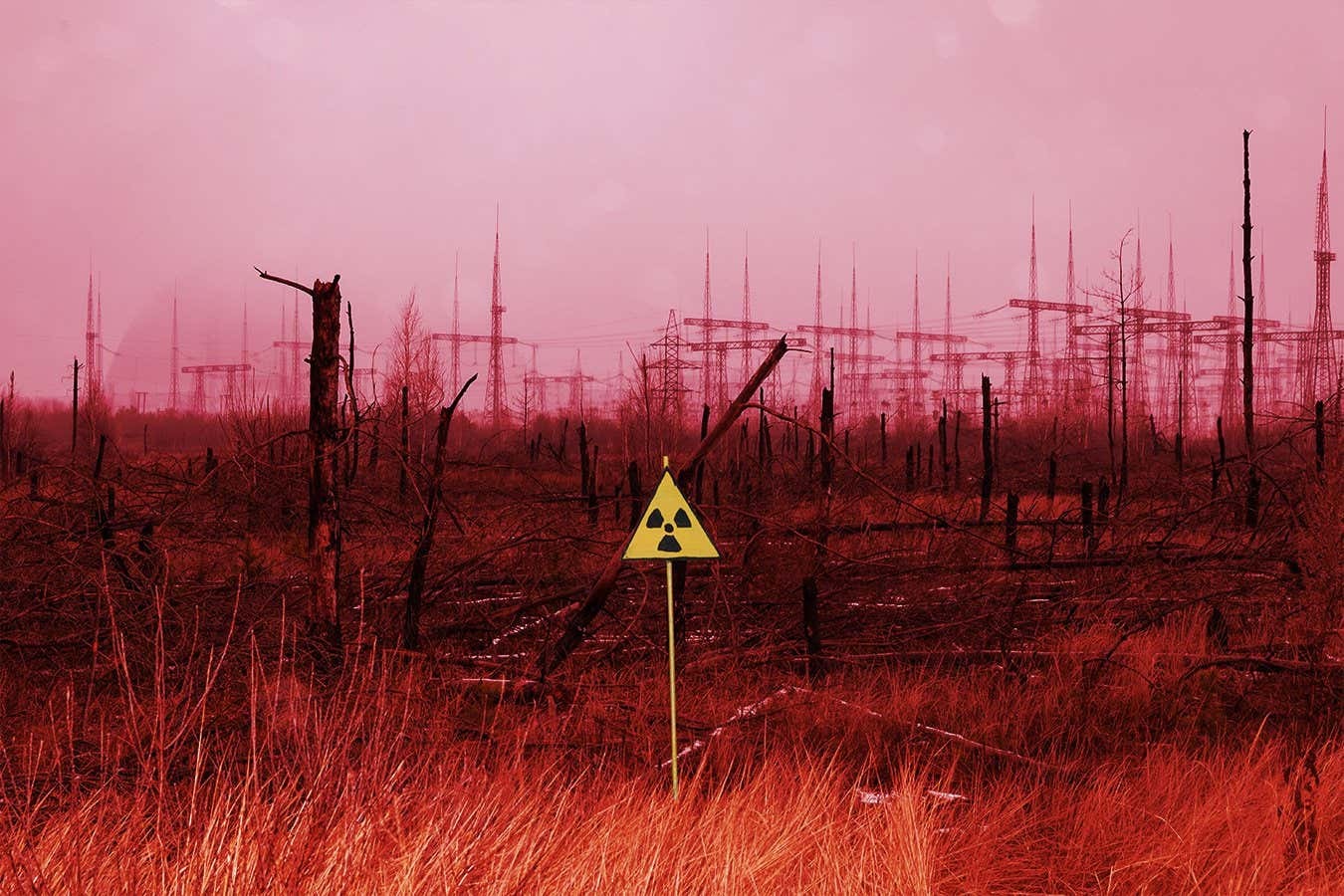
Forty years after the catastrophic explosion of Reactor 4, the Chernobyl Exclusion Zone remains one of the most complex landscapes on Earth. What was once a site of unprecedented nuclear failure has evolved into a unique scientific laboratory, a thriving (if accidental) nature reserve, and now, a scarred battlefield.
As the world approaches the four-decade mark of the disaster, the story of Chernobyl is no longer just about the physics of a meltdown; it is about the enduring struggle to manage a toxic legacy amidst geopolitical chaos.
The Science of Decay: What Remains?
The danger posed by Chernobyl is not a monolith; it changes depending on the isotope in question. Following the 1986 explosion, over 100 radioactive materials were released. Understanding the “half-life”—the time it takes for a substance to lose half its radioactivity—is key to understanding the current risk:
- Short-term threats: Iodine-131 was a primary concern in the immediate aftermath due to its impact on the thyroid, but its short half-life meant it dissipated quickly.
- Mid-term threats: Materials like caesium-137 and strontium-90 have half-lives of roughly 30 years. Their influence is currently beginning to fade, though they remain part of the environmental background.
- Eternal threats: The most significant danger lies in the concentrated remains of uranium-235 and plutonium-239 inside Reactor 4. With half-lives spanning tens of thousands to millions of years, these materials represent a permanent geological fixture that will require management for millennia.
From Scientific Sanctuary to War Zone
For decades, the Exclusion Zone was defined by scientific inquiry. Researchers studied everything from radiation-eating bacteria to the resilience of wildlife. The completion of the New Safe Confinement (NSC) in 2016—a massive €1.5 billion arch designed to encase the ruins—offered a glimmer of hope for a century-long decommissioning process.
However, the 2022 Russian invasion of Ukraine fundamentally disrupted this progress. Chernobyl’s strategic location between the border and Kyiv made it a primary target. The occupation brought a new kind of devastation:
– Vandalism and Theft: Russian troops looted laboratories, destroyed data, and even stripped components from equipment.
– Militarization: The zone is now heavily fortified, turning scientific sites into classified military zones.
– Hidden Dangers: The landscape is now littered with landmines. This has created a lethal irony: while radiation is a slow, invisible threat, landmines pose an immediate, kinetic danger to both soldiers and the wildlife that has reclaimed the area.
The Myth of the “Ghost Town”
There is a common misconception that Chernobyl has been a deserted wasteland since 1986. In reality, the power plant remained operational for years, with reactors running until as late as 2000.
Even today, the zone is not entirely empty. A small population of “self-settlers”—mostly elderly residents—continues to live in the area. For people like 88-year-old Yevhen Markevich, the zone is not a death trap, but a home. While experts note that the radiation levels in much of the zone are comparable to natural background radiation found elsewhere in the world, the psychological weight of living in a nuclear graveyard remains profound.
The Global Impact: A Costlier Legacy
Perhaps the most significant legacy of Chernobyl isn’t the local contamination, but its impact on global energy policy. The disaster fueled a worldwide “radiophobia” that significantly slowed the adoption of nuclear power.
This shift has had unintended environmental consequences. As nuclear expansion stalled, many nations turned back to fossil fuels. Researchers suggest this pivot contributed to increased air pollution, potentially cutting millions of global life years. In this sense, the “cost” of Chernobyl extends far beyond the borders of Ukraine; it is a factor in the global climate and public health equation.
The challenge of Chernobyl is no longer just about containing a reactor; it is about managing a contaminated landscape that is simultaneously a scientific treasure, a biological sanctuary, and a frontline in a modern war.
Conclusion
Chernobyl remains a living monument to human error and scientific resilience. As Ukraine navigates the dual challenges of war and nuclear decommissioning, the site continues to serve as a critical lesson in how humanity manages the long-term consequences of its most powerful technologies.