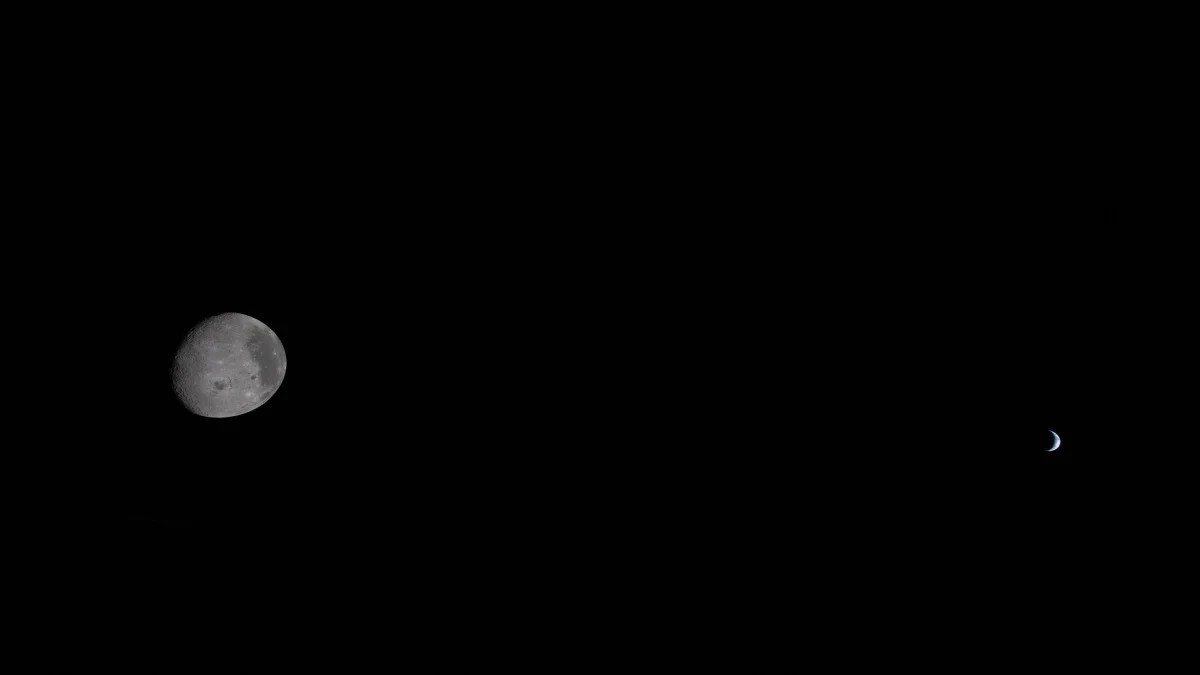
A single photograph from the Artemis II mission has captured the profound isolation and connection of our existence in the cosmos. In a side-by-side view, a massive, craggy gray moon dwarfs a tiny, blue crescent Earth, illustrating just how fragile our home appears against the vastness of space.
While many space agencies have captured similar views using robotic probes, this image is fundamentally different: it was taken by a human eye, through a human window, and with a human hand.
The Shot That Defined a Mission
Captured on April 6 by Commander Reid Wiseman from inside NASA’s Orion spacecraft, the photo utilized a 14-24mm wide-angle lens to frame the moon and Earth simultaneously. At the time, the capsule was approaching the far side of the moon, providing a perspective rarely seen by human eyes.
The mission itself was a historic milestone. Launched on April 1 via the Space Launch System (SLS) rocket, the Artemis II crew—Reid Wiseman, Victor Glover, Christina Koch, and Jeremy Hansen —became the first humans to journey around the moon in over half a century.
Key Mission Milestones:
– Maximum Distance: The crew reached a record 252,756 miles from Earth.
– Lunar Proximity: The spacecraft swung within 4,067 miles of the lunar surface.
– Total Distance Traveled: Over the 10-day mission, the crew covered nearly 694,481 miles.
– Successful Return: The mission concluded with a splashdown in the Pacific Ocean on April 10.
More Than Just a Pretty Picture: The Science of Survival
While the imagery is breathtaking, Artemis II was primarily a high-stakes test flight. NASA used this mission to validate essential systems before committing to long-term lunar habitation.
The crew acted as living sensors, providing critical data on several fronts:
– Life Support: Testing how Orion’s systems sustain humans in deep space.
– Manual Navigation: Astronauts took control of the spacecraft to gather data necessary for future docking maneuvers with lunar landers.
– Biological Impact: Studying how human tissue and performance react to weightlessness and high-radiation environments outside Earth’s magnetic shield.
This data is the “homework” required for the next phase of exploration: NASA’s goal to land humans near the lunar south pole by 2028.
The “Human Element” in an Age of Automation
In an era increasingly dominated by artificial intelligence and autonomous probes, the Artemis II imagery serves as a reminder of the unique value of human exploration.
While robotic missions like Voyager 1 or China’s Chang’e-5 have provided spectacular views of our celestial neighborhood, they lack the emotional weight of a crewed mission. For the astronauts, the view wasn’t just a data point; it was a realization of our planet’s vulnerability.
“Earth was just this lifeboat hanging undisturbingly in the universe.”
— Christina Koch, NASA Astronaut
The psychological toll of the mission was also evident. Commander Wiseman noted that while space travel is a “greatest dream” before launch, the reality of being 200,000 miles away creates a profound longing for home and connection.
Conclusion
The Artemis II mission has successfully transitioned from a theoretical goal to a proven capability, providing the vital data needed for deep-space survival. Beyond the technical successes, the mission has provided humanity with a new, deeply personal visual record of our place in the universe.