Old isn’t old enough anymore. Not for amber.
A team of paleontologists has uncovered the oldest confirmed fossilized resin ever found, hiding in coal seams deep within China’s Xinjiang region. It dates back 385 million years to the Middle Devonian epoch. That is roughly 65 million years older than the previous record-holder.
The implication? Early resin production in plants evolved way before seed plants even existed. We’ve always thought amber came from conifers and ferns with seeds. This new discovery forces a hard pivot. The machinery for making resin appeared earlier, in simpler ancestors.
Where Did the Oldest Amber Come From?
The find isn’t from a pristine beach. It was extracted from a dirty coal seam near Hoxtolgay, China. Specifically, the Hujiersite Formation.
Dr. Cihang Luo and his team from the Nanjing Institute of Geology palaeontology and the Senckenberg Research institute dug up about 10 kg of that coal. Then they looked closely. Using ultraviolet light, they spotted small clusters glowing within the dark matrix.
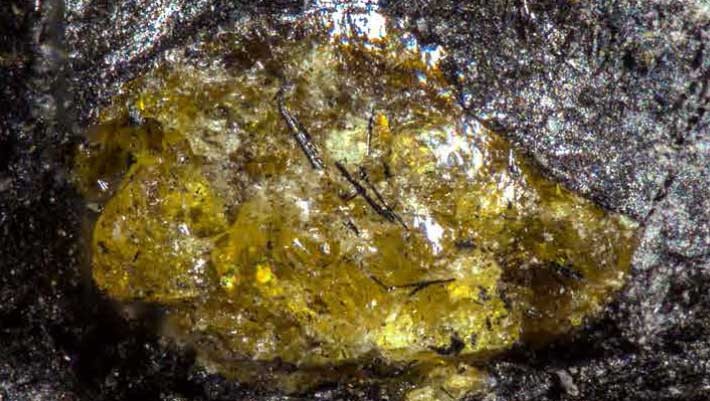
Under microscopes, they plucked out 241 tiny fragments. Most are microscopic, ranging from 0.1 to just 0.5 mm wide. Some are translucent yellow; others, dark brown opaque blobs. They fluoresce bright blue under UV light. Some hold ancient air bubbles.
For context, the oldest previously verified amber was Late Carboniferous. About 320 million years old, from the US or Canada. This Hujiersite material predates it significantly.
“Amber, specifically fossilized resin… helps plants recover from various biotic and we biotic injuries,” Dr. Luo said. “These resins… transform into amber during diagenetic… processes under elevated temperatures and pressures.”
It’s messy chemistry turning into hard rock. Over millions of years. Under heat. And pressure.
Why Was This Resin Produced by Seedless Plants?
Here’s the puzzle. Chemical analysis shows the Hujiersite amber looks almost identical to modern conifer resin. But conifers hadn’t evolved yet. Not at 385 million years ago. Seed plants (spermatophymes) didn’t really explode until the Late Devonian, later than this amber formed.
So what made it?
Using Fourier transform infrared spectroscopy mass spectrometry, scientists ruled out flowering plants. They looked at local fossils instead. The best candidates? Progymnosperms or tree-like lycopsids.
Progymnosperms were seedless. They gave rise to seed plants. Lycopsids were ancient vascular plants. Fossils of both exist in that same layer. Neither left actual tissue preserved with the resin, so we can’t be 100% sure which one leaked it. But it has to be one of them.
This suggests the biochemical pathway for complex terpenoid resins evolved in non-seed vascular plants. A trait long associated only with gymnosperms. It flips the timeline.
Did Insects Cause the First Resin?
Maybe. Probably not.
We love thinking about mosquitoes trapped in amber, buzzing lazily into history. But insect evidence doesn’t appear prominently until later. The Carboniferous period brought more aggressive bugs.
Back in the Middle Devonian, the threats were different.
“Early resin likely served to seal wounds… rather than to deter insect feeding,” the researchers note.
Fire was likely the catalyst. Wildfires were common by the Devonian. Trees got burned. Bark tore. Plants needed to patch holes. To stop fungi from invading open wounds. So they leaked sticky sap. That sap hardened. Millions of years later, it became the amber we see now.
What Does This Mean for the Fossil Record?
Amber is rare. Sporadic. Gaps in the geological record make sense.
Before this find, pre-Permian amber was nearly nonexistent. Just two confirmed records from the Carboniferous (US and Canada). This single batch of 241 pieces bridges a huge gap.
It confirms that resin biosynthesis isn’t exclusive to the “seed” lineage. It’s a survival tool for vascular plants broadly. A sealant for scars caused by nature’s violence.
The paper was published July 15, 2024 in Science Advances. (Cihang Luo et al. “The earliest amber from the Middle Devonium of China.”)
Does this mean there’s even older resin out there, buried deeper, waiting to be squished into visibility? Likely. The Devonian is old, yes, but the Silurian is older. The Cambrian, oldest still.
If progymnosperms made resin to stop rot and fire damage, perhaps their ancestors did something similar. Simpler chemicals. Maybe.
For now, these 241 specks of yellow-glowing matter rewrite the textbooks. Seeds didn’t start the party. The tree-like predecessors did.
We look for bugs in amber. We should maybe be looking at the bark scars too.