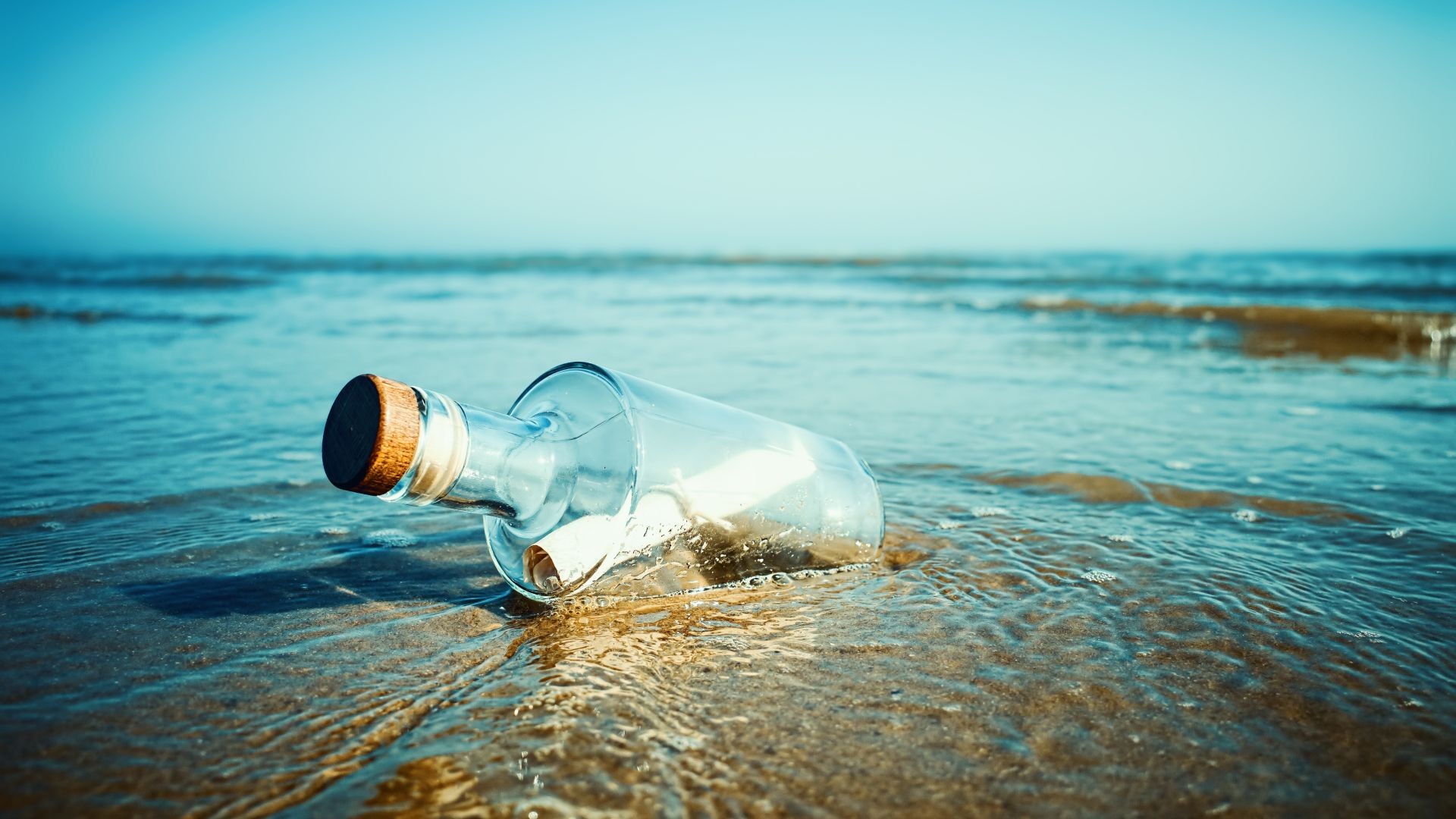
A recent discovery on the southwest coast of Australia has captured the public imagination: a 100-year-old message in a bottle, written by a World War I soldier declaring himself to be “as happy as Larry.” While such a find feels like a stroke of pure magic, it is actually a rare intersection of oceanography, physics, and probability.
If you were to cast a message into the sea today, what are the actual mathematical chances of it being recovered a century from now?
The Perils of the Ocean
Finding a message in a bottle is an uphill battle against nature. For a bottle to be recovered after a century, it must survive several existential threats:
– Degradation: Sunlight and saltwater gradually weaken the glass or plastic and decay the paper inside.
– Sinking: If the seal fails and water enters, the bottle becomes heavy and sinks to the seafloor, effectively vanishing.
– Geography: The ocean is vast. A bottle may drift into remote, uninhabited regions where it will likely never be seen by human eyes.
Calculating the Probability
To determine the likelihood of finding a “centenarian” bottle, we cannot simply look at one number. Instead, mathematicians use the multiplication rule of probability. This involves breaking the problem into two distinct parts:
- Probability A: The chance that a message in a bottle is found at all.
- Probability B: Given that a bottle is found, the chance that it is over 100 years old.
By multiplying these two probabilities together, we arrive at the final likelihood.
Step 1: The Recovery Rate
How likely is it that any bottle is found? Experts from Germany’s Federal Maritime and Hydrographic Agency suggest a 1 in 10 chance. This is supported by historical “drift bottle” experiments used by oceanographers to track currents. For instance, studies in the North Atlantic have shown recovery rates ranging from 5% to 14%, depending on the specific region and currents involved.
Step 2: The Age Factor
The second challenge is the age of the recovered bottles. Data suggests a clear trend: the older the bottle, the fewer there are to be found. As time passes, the probability of a bottle breaking or sinking increases.
By analyzing historical data from news reports of recovered bottles, researchers can estimate the distribution of ages. While many bottles are found within the 0–25 year age range, the numbers drop significantly as we move into higher age brackets. Based on statistical modeling of these trends, it is estimated that only about 1 in 10 recovered bottles are over 100 years old.
The Final Verdict: Your Odds
When we combine these two factors—the 1/10 chance of recovery and the 1/10 chance of it being a century old—the math becomes clear:
(1/10) × (1/10) = 1/100
This means that for every 100 bottles cast into the sea, only one is expected to be found after 100 years.
To put this into a human perspective: if there are 100,000 such bottles currently drifting in the world’s oceans, we expect only 1,000 of them to be found as century-old relics. With a global population of 8 billion people, your personal chance of stumbling upon one is approximately 1 in 8 million.
Where to Look?
If you are determined to defy these odds, you shouldn’t just wander any beach. Success depends on understanding ocean gyres —large systems of circulating ocean currents.
Because bottles follow these currents, the best places to search are islands or peninsulas that intersect with major gyres. For example, the Caribbean islands are strategically positioned along the North Atlantic Gyre, making them statistically better locations for “bottle hunting” than many other parts of the world.
Conclusion
While finding a century-old message is statistically improbable, it is a mathematical certainty that such treasures exist within the ocean’s currents. For the lucky few, these bottles serve as rare, physical links to the past, carried across the waves by the very currents that make them so difficult to find.