The Chinese space agency finally showed us something. A photo. It is blurry, though.
Tianwen-2 arrived at its target. It circled a rock called Kamo’oalewa. This rock isn’t a true moon, strictly speaking, but it plays the part while orbiting the sun alongside us. Quasi-satellite sounds pretentious until you realize this asteroid will eventually drift off. Leave us entirely.
The CNSA didn’t share much at first. Launched on May 28 from Xichang, the probe sat in silence for weeks. Now? On July 6, state media Xinhua confirmed arrival. It orbited on June 7 after a 400-day trek over 600,00 miles. That aligns with earlier predictions, but the secrecy feels heavy.
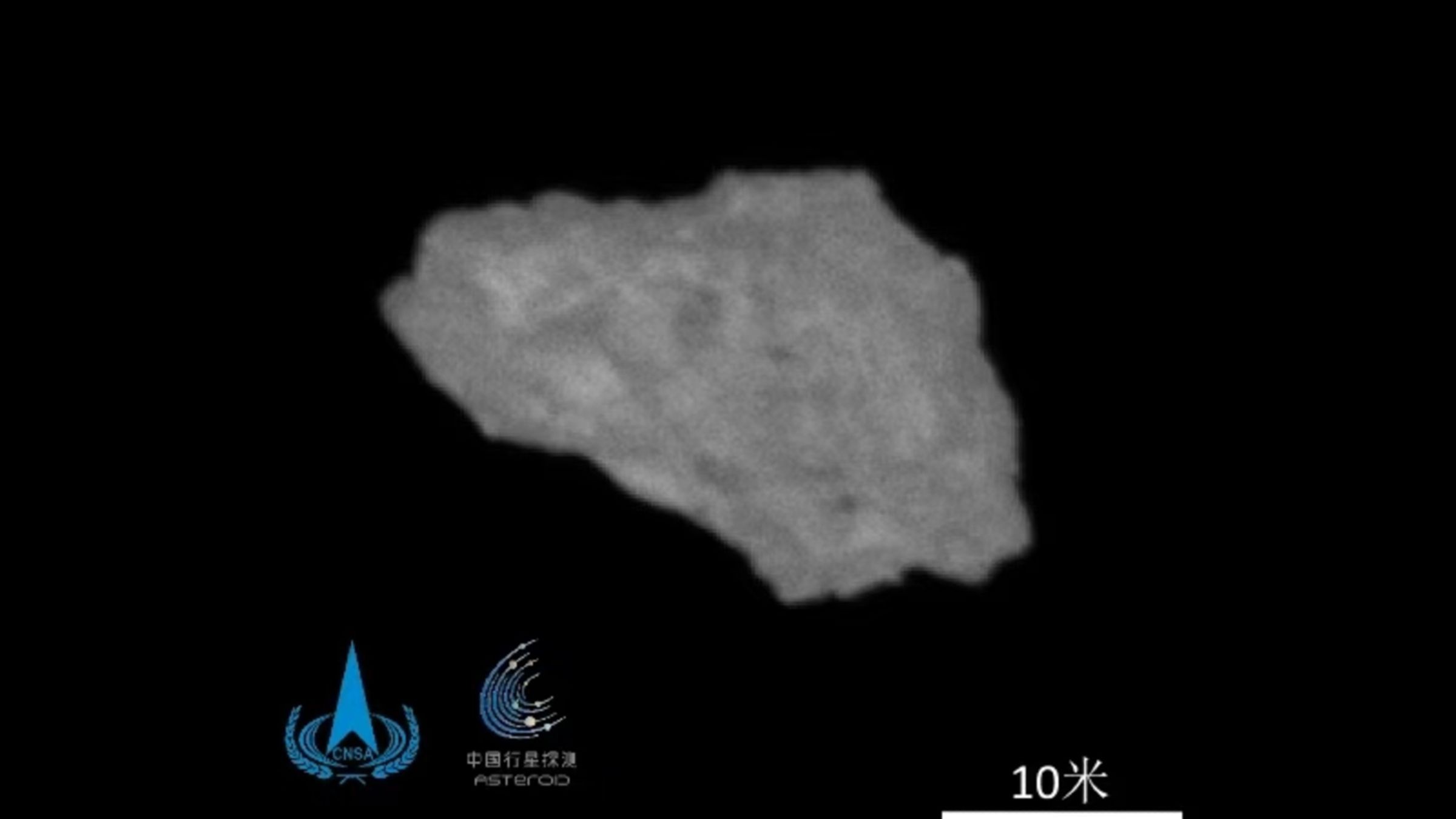
Here is the image released. Captured from 12.5 miles away, it reveals a problem. The rock is small. Roughly 130 feet across. Maybe 40 meters. Previous guesses said it could be nearly three times that size. A 100-meter estimate vanished into a much tighter margin.
It is also fragile.
Early data screams “rubble pile.” Loosely held together by weak gravity and dust. The surface is unstable. Remember the original plan? An “anchor and drill” technique. A bold, almost sci-fi maneuver to sink into a solid surface. Forget that. It’s unlikely now. The rock spins too fast, crumbles too easily, and offers no flat landing zone. Just jagged chaos.
“Complexity” and “risk” are words the CNSA actually used in their report. They didn’t have to use them, but they did. Sampling this thing is going to be harder than anyone admitted on day one. The sampling window supposedly opened on July 4. Nothing happened. Yet. Scientists are likely stuck figuring out how to touch this moving target without destroying it—or themselves.
They plan to gather more data on morphology and internal structure. Step-by-step. Cautiously. If they get the samples, they drop them in a capsule for Earth re-entry in November 2027. 27,00 mph. A violent end for the container. China would then be third. Following Japan’s Ryugu and America’s Bennu. A tight race for scientific bragging rights.
Why go to such lengths for a blurry potato-shaped rock?
Because we need answers. About water. About organic molecules. About why life exists here. There’s a lingering theory that Kamo’oalewa might actually be lunar debris. Chunks knocked loose by an ancient meteor hitting the moon. Marco Fenucci of the European Space Agency calls it an open debate. Samples could prove or disprove that it belongs to Earth’s companion, not the void between planets.
And that is just the first part.
Tianwen-2 isn’t retiring. After dropping samples in 2027 it slingshots past us again. Deeper out. Toward Mars and beyond. In 2035, it studies 311P/PanStarS—a weird object that is both comet and asteroid. The probe keeps working while we wait to see if those rocks were ever really part of our moon.