The data wasn’t supposed to be there.
Astronomers weren’t even looking for it.
It started in 2010. A brief, 36-minute window of exceptionally clear skies over the Canary Islands. Michiel Rodenhuis was waiting for the sky to darken. Instead, he spotted Venus blazing in the twilight. He had a quirky experimental instrument pointed at the sky anyway. He turned it toward the planet. He collected the data.
Then, life moved on. Rodenhuis finished his PhD. The Extreme Polarimeter, or ExPo, was dismantled. Its parts found new homes in other experiments.
Months later, a fresh pair of eyes saw something wrong in the Venus data.
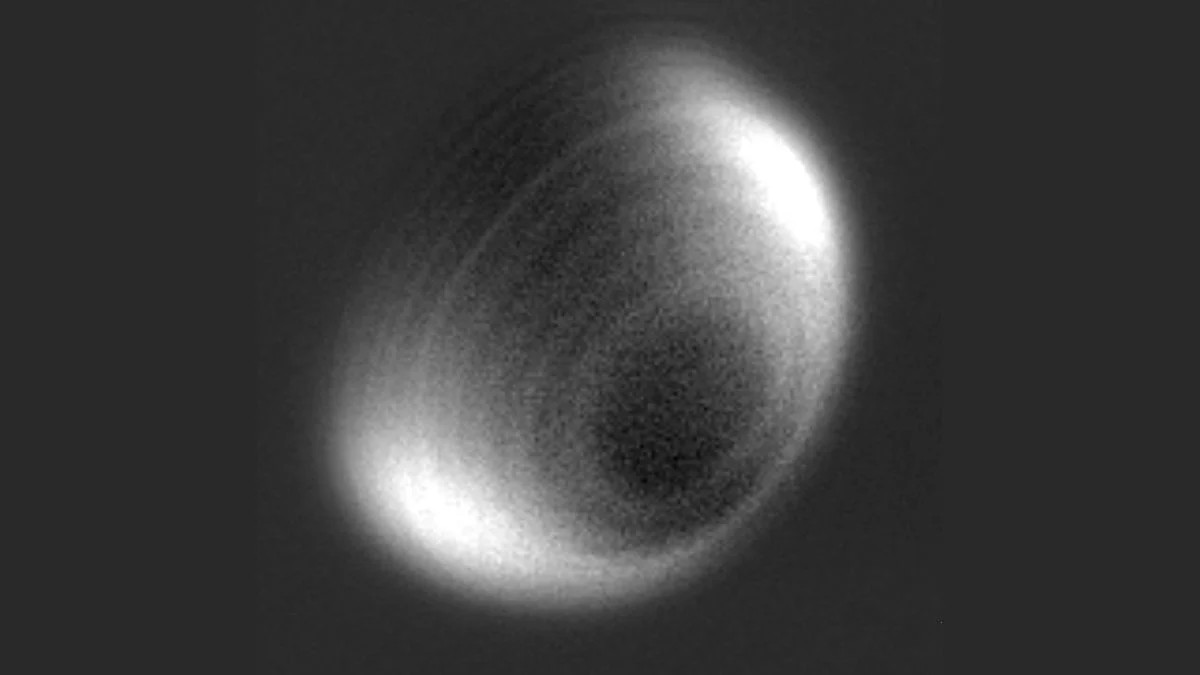
Vast, concentric rings encircled the day side of the planet. They were invisible in standard light. You could only see them if you looked at linearly polarized light. As if Venus was ringing like a struck bell.
The initial reaction? Instrument error.
Natural. When you see something that defies expectation, you blame the tools first. The rings centered on the brightest part of the disk. That screams artifact. Maybe a digitization glitch in the detector. Maybe signal smearing. Maybe Rodenhuis just messed up the alignment.
They tried to debunk it. Hard.
Gourav Mahapatra, now an atmospheric physicist at Delft University, spent years trying to prove the signal wrong. He ran simulations. He checked the hardware specs. He looked for noise.
The signal persisted.
Every test confirmed what was already there: the rings were real, or at least, the instrument didn’t lie.
“It is quite frustrating to have potentially unique observations that cannot be confirmed,” Mahapatra told ScienceAlert.
But science isn’t about being right. It’s about being honest about uncertainty. Rather than let the paper sit unpublished while they waited for a miracle repeat of a 2010 sunset, Mahapatra and his team did something risky. They published it. They explained the limitations. They showed the physics was plausible. They invited the wider community to tear it apart.
How Venusian Gravity Waves Create Polarization Rings
If you’ve never heard of Venusian atmospheric superrotation, now is a good time. It’s one of the most bizarre phenomena in the solar system. Venus spins on its axis incredibly slowly—a single day lasts 243 Earth days. But the clouds? They orbit the planet four times faster. Winds whip around at hurricane speeds, completing a circuit in just four Earth days.
What keeps those winds moving?
Energy. Transported by waves.
Atmospheric gravity waves aren’t new to science. On Earth, they manifest as ripple patterns in the clouds. Like stones thrown into a pond. On Venus, the atmosphere is thick, hot, and composed mostly of carbon dioxide with sulfuric acid clouds. The waves stretch for thousands of kilometers. They compress and expand the gas as they travel.
Mahapatra’s hypothesis was elegant in its simplicity.
Could atmospheric gravity waves cause density variations in the upper atmosphere? And could those density changes scatter sunlight in a way that creates polarized rings?
He ran the computer models. He simulated realistic density fluctuations—variations of just 5 to 10 percent.
The result? A hit.
The simulation produced polarization rings that looked exactly like the 2010 data.
“Realistic density variations of 5 to 10 percent… could indeed produce polarization rings similar to those seen in the 2010 observations.”
It wasn’t proof. It was a strong hint.
The rings themselves aren’t the waves. They are the signature of the waves. Small changes in air density alter how light scatters. The Extreme Polarimeter detects linear polarization. It ignores the unpolarized glare. It catches the subtle shifts.
Why This Matters for Planetary Science
You might wonder why we care about rings around a cloudy rock.
It comes down to physics. The same rules that govern Venus’s atmosphere also apply to Earth’s. Just with different parameters. Different compositions. Different temperatures.
If Mahapatra is right, this is a new window into atmospheric dynamics.
“We regard our observations not as evidence for a completely unknown kind of atmospheric physics, but potentially as a new way of observing atmospheric dynamics,” Mahapatra noted.
It helps solve the superrotation mystery. These waves carry momentum across the planet. From pole to pole. From day side to night side. If we can track them, we can track the engine driving Venus’s winds.
Japanese spacecraft Akatsuki has already seen pole-to-pole waves in the atmosphere. That proves the planet is capable of large-scale wave activity. This new data suggests we can see the effects of those waves from Earth using polarimetry.
It’s not about discovering new laws of physics. It’s about finding new tools to understand old ones.
The Search for Confirmation
Here’s the catch.
The data comes from one night. In 2010. On an instrument that no longer exists.
No one has replicated the observation.
That makes it scientifically awkward. It’s an outlier. It’s fragile. But it’s physically sound.
So what’s next?
We need new eyes on Venus.
Rodenhuis is gone from this specific setup. But telescopes in the Canaries still stand. New polarimeters have been built since 2010. More sensitive. More precise. Some are even experimental, just like ExPo was.
“With a telescope on Earth, these rings can in principle be observed,” Mahapatra said.
The paper is published in The Planetary Science Journal. The ball is in the court of other researchers. Someone needs to point a modern polarimeter at Venus during a clear night. Someone needs to look for the rings.
If they find them, the mystery begins in earnest.
If they don’t?
Well, then the instrument was wrong. And that’s also a result.
But Mahapatra thinks the waves are there. He suspects they appear after local noon. Linked to solar heating. Carrying energy through the dense cloud layers.
It’s a puzzle. A beautiful, frustrating puzzle. And for now, Venus is still hiding its secrets behind thick sulfuric acid curtains. But we’re learning how to look closer.
The rings are waiting. Someone just needs to see them. Again.