


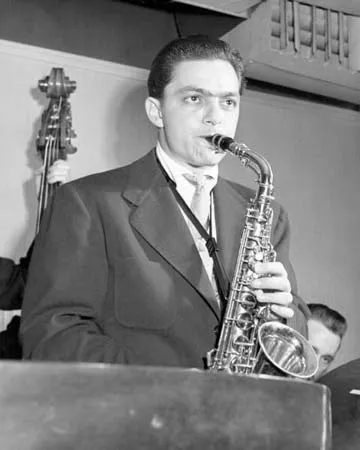
Most people think of West Coast jazz as sterile. They picture beige cardigans and cool, detached vibes. But Art Pepper proved that wrong. Born in Gardena, California, in 1925, he brought a burning intensity to the alto saxophone that shattered the “cool jazz” stereotype. He was a major figure in the 1950s scene. His sound had a rare, beautiful clarity. Even small note values came through with precision. His improvisations were emotionally charged. He didn’t just play notes. He created tension.
From Army to Stan Kenton
Pepper didn’t start out as a legend. He started in local bands. As a teenager in Los Angeles, he played with leaders like Lee Young and Benny Carter. Those swing-era influences stuck with him. Then came the Stan Kenton band. He joined briefly in his teens. He left to serve in the U.S. Army from 1944 to 1946. When he returned, he joined Kenton again in 1947. He stayed until 1952.
That departure marked a turning point. He began leading his own recording groups. The late 1950s were a golden window. Between 1956 and 1960, he recorded prolifically. It was a productive burst. Then life intervened. Hard.
The Long Road Back
Narcotics addiction and prison terms derailed his career in the 1950s. He wasn’t alone in that era, but his struggle was public and brutal. He spent most of 1961 to 1967 behind bars. Physical ailments followed release. He entered Synanon for rehabilitation. That lasted three years.
Performing became intermittent. You might wonder how he recovered at all. But by the late 1970s, he was back on the road. He resumed frequent recording and touring. His sound remained outstanding until his death in Los Angeles on June 15, 1982.
A Unique Sound
What made him stand out? It wasn’t just technique. It was feeling. While other white West Coast musicians leaned into cool detachment, Pepper’s improvising was intensely emotional at all tempos. He was a sensitive interpreter. Listen to his 1956 recording of Hoagy Carmichael’s “Winter Moon.” You hear it there.
He played alto saxophone with a brilliant, pure tone. He also played clarinet and tenor saxophone occasionally. His solos used broken phrases. Asymmetric accents. He formed melodic lines with rare, compelling tension. He drew influence from bop-era giants like Charlie Parker and Lee Konitz.
Essential Recordings
If you want to hear what he sounded like at his peak, start with specific albums. His 1956 track “Besame Mucho” is a standout. Check out Art Pepper Meets the Rhythm Section from 1957. The Way It Was (1960) and Smack Up (1960) are also essential. These albums capture the raw power of his alto work.
By the 1970s, his style evolved. Influenced by John Coltrane, he incorporated modal material. He used cyclic forms. He experimented with dissonant, sheets-of-sound elements. His soloing adapted. It remained outstanding.
The Straight Life
Pepper’s story didn’t end with music. It became a