Ernest Rutherford did not just tweak the existing understanding of matter. He shattered it.
In 1911, this New Zealand-born physicist proposed a radical new Rutherford model of atomic structure. It was a stark departure from the soft, pudding-like theories that dominated the scientific community at the time.
The idea was simple but devastatingly effective.
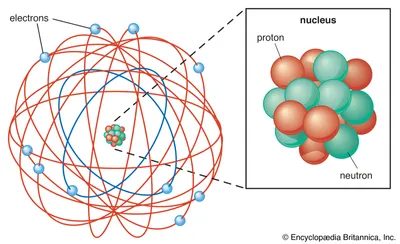
He described the atom not as a uniform blob, but as a system defined by vast empty space. At the center sat a tiny, dense core. He called it the nucleus. Nearly all the mass of the atom resided here. It carried a positive charge.
Orbiting this heavy core were light, negative particles. Electrons. They circled at a distance. The analogy was unmistakable. It mirrored planets revolving around the Sun.
This was the birth of the nuclear atom.
The Planetary Analogy
Think of the scale. If the nucleus were a marble on the center field of a baseball stadium, the electrons would be gnats buzzing in the highest seats of the stands. The rest? Empty void.
This Rutherford model explained why most alpha particles shot at gold foil passed straight through. They missed the nucleus. The electrons were too small to deflect them.
But some bounced back.
This scattering proved the existence of that concentrated positive charge. It forced a rethink of how matter holds together. The atom was no longer a solid sphere. It was a dynamic system of forces.
Why It Mattered
Before Rutherford, atoms were viewed as indivisible or vaguely structured. His proposal introduced a clear architecture.
It established the nucleus as the anchor. The electrons became the active, peripheral players. This shift laid the groundwork for everything that followed. Quantum mechanics. Nuclear physics. The understanding of isotopes.
The model wasn’t perfect. It couldn’t explain why the electrons didn’t crash into the nucleus due to electromagnetic radiation. That problem would take decades to solve.
But the core insight held. The atom has a center. It has mass concentrated in one spot. And it has space.
“The atom is mostly empty space with a dense, positive center.”
This wasn’t just a diagram. It was a new way to see reality. We still use this basic framework today. The nucleus remains the heart of the atom. The electrons define its behavior.
We stand on the shoulders of that 1911 insight. The rest is just filling in the details of a vast, invisible universe.
Why the Atom Is Mostly Empty Space
The discovery of the atomic nucleus didn’t happen in a vacuum. It started with a simple, stubborn question about what happens when you shoot high-speed particles at metal. In 1909, Ernest Marsden, an undergraduate working under Ernest Rutherford and Hans Geiger, set up an experiment that would rewrite physics. They weren’t just looking for answers. They were looking for what they didn’t expect.
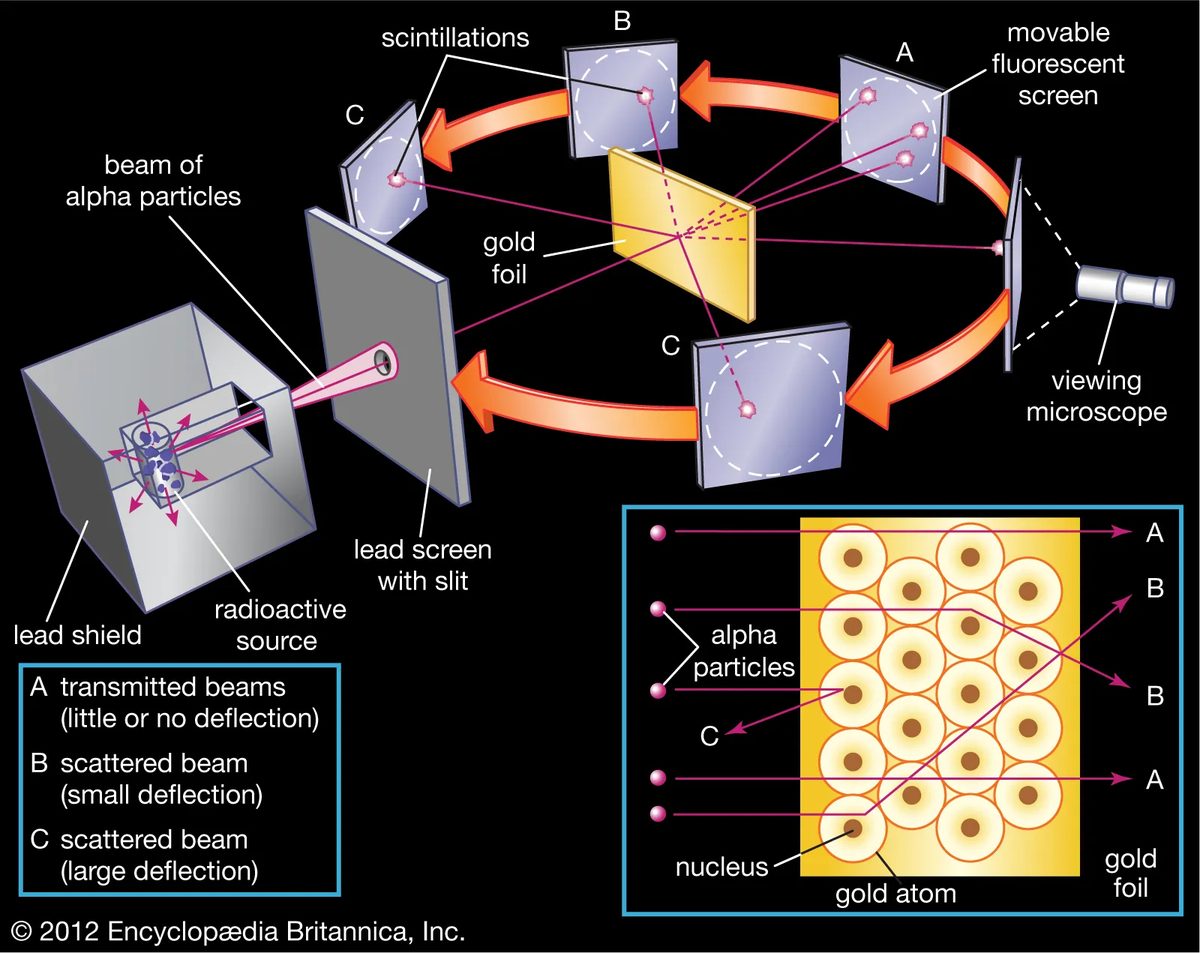
The setup was rudimentary by modern standards but precise enough to change everything. A radioactive source emitted alpha particles. These are positively charged particles, essentially helium nuclei, and they are roughly 7,000 times more massive than electrons. The team shielded the source in lead and forced the radiation through a narrow slit. The result was a tight beam aimed directly at a sheet of gold foil thinner than a human hair.
Behind the foil sat a screen coated in zinc sulfide. When an alpha particle hit this screen, it created a tiny flash of light, a scintillation. Rutherford and his team spent nights in a darkened room, looking through a microscope, counting these flashes. The screen could move. This allowed them to check if particles were bouncing off at odd angles.
Most particles did exactly what everyone thought they should. They went straight through. This implied that atoms are mostly empty space. But a small fraction of the beam behaved strangely. Some deflected slightly. A few scattered at wide angles. And a tiny number bounced straight back toward the source.
Rutherford later compared this to firing a 15-inch naval shell at tissue paper and having it rebound to hit you. It was absurd. It shouldn’t have happened. The only way to explain such violent repulsion was if the atom’s positive charge wasn’t spread out evenly. It had to be concentrated in a small, dense center.
This center became known as the atomic nucleus.
The Planetary Model Takes Shape
With the nucleus identified, the rest of the atom’s structure fell into place by necessity. The positive charge of the nucleus had to be balanced by negative electrons. Rutherford proposed that these electrons orbited the nucleus much like planets orbit the sun. The electrostatic attraction held them in place, mimicking gravity’s hold on the solar system.
This was the Rutherford model of the atom. It replaced J.J. Thomson’s earlier “plum-pudding” theory. Thomson had suggested electrons were embedded in a diffuse positive sphere, like plums in a dessert. Rutherford’s data killed that idea. The atom wasn’t a solid blob. It was a vast, mostly empty arena with a heavy core at the center.
But the model wasn’t perfect. It relied entirely on classical physics. According to those laws, an orbiting electron should constantly radiate energy. It should spiral inward and crash into the nucleus in a fraction of a second. The atom should collapse. It didn’t.
That flaw didn’t go unnoticed. Within a few years, Niels Bohr stepped in. He introduced early quantum theory to fix the instability. The electrons, Bohr argued, could only occupy specific orbits. They didn’t spiral down. They jumped between levels. This Bohr atomic model superseded Rutherford’s planetary vision, but the core discovery remained the same.
The gold foil experiment proved that matter is not solid in the way we experience it. It is sparse. It is held together by forces we cannot see. The nucleus is incredibly small, yet it contains almost all the mass. The rest is just space.
We still use this framework today. We just know the electrons don’t orbit like neat planets. They exist in probability clouds. The math is harder. The reality is weirder. But the central insight holds.
The atom is mostly nothing. And that’s why it works.