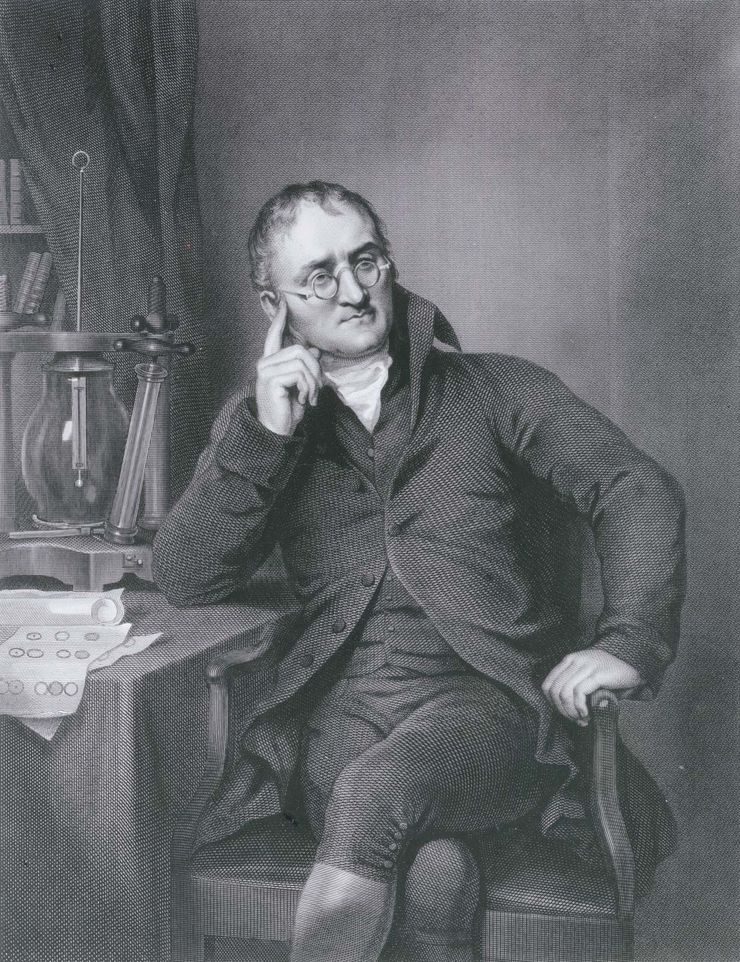
Most of John Dalton’s life unfolded far from the polished lecture halls of elite universities. He was a quiet figure, rooted in Manchester and the surrounding English countryside, spending decades in private teaching and solitary research. It was in this unglamorous setting that he reshaped how we understand matter.
Today, he is remembered as one of the fathers of modern physical science. But his path there wasn’t straight. It started with a simple observation about air.
How Dalton’s Law Changed Gas Science
Dalton’s interest in gases led him to what we now call Dalton’s Law of Partial Pressures. Before this, people treated air as a monolithic blob. Dalton realized that if you mix gases, each one acts independently. The total pressure is just the sum of the pressures each gas would exert on its own.
This wasn’t just a neat trick. It was a foundational shift. It moved chemistry away from vague qualitative descriptions and toward hard numbers. You could finally measure things.
Why Atomic Theory Matters Today
His biggest contribution, however, was the atomic theory. He proposed that every element is made of tiny, indestructible particles called atoms. These atoms are identical within an element but different from atoms of other elements. Each has a specific atomic weight.
This synthesis elevated chemistry to a quantitative science. Before Dalton, chemistry was often alchemy-adjacent, full of mystery and imprecision. After him, you could do math with matter. You could predict reactions. You could build things based on solid evidence.
The First Color Blindness Study
Dalton wasn’t just a theorist. He was an observer. In 1794, he became the first person to describe color blindness. He noticed he saw colors differently than his brother. The term “color blindness” wasn’t used then, but the phenomenon was documented. It’s named after him because he studied it so closely.
This wasn’t a side note. It shows his meticulous attention to detail. He saw what others missed.
A Life of Observations
His meteorological journal is staggering. It contains over 200,000 observations. He recorded temperature, humidity, wind direction, and precipitation every single day for decades. This wasn’t busywork. It built a dataset that allowed him to understand patterns in nature.
He also devised a system of chemical symbols. He ascertained the relative weights of atoms and arranged them into a table. This table was the precursor to the periodic table. Mendeleev stood on Dalton’s shoulders.
Where Dalton’s Work Fits Now
We take atomic theory for granted. It’s in every chemistry textbook. But it wasn’t always there. Dalton’s work made it possible. He turned chemistry into a science of measurement.
He died in Manchester on July 27, 1844. But his ideas didn’t die with him. They became the bedrock of modern physics and chemistry.
The Legacy of Precision
Dalton’s life was quiet. His impact was not. He showed that careful observation, combined with rigorous thinking, can change a field forever.
He didn’t seek fame. He sought truth. And he found it in the air around him, in the colors he saw, and in the atoms he couldn’t see but knew were there.
That’s why he matters. Not