We found something. Not gas giants. Not fluffy sub-Neptunes.
An atmosphere on a rocky world.
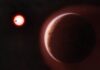
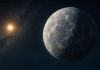
LHS 1140 sits 49 light-years away, tucked into the constellation Cetus. It orbits a dim red dwarf star. This place could hold liquid water. And it definitely holds air.
Collin Cherubim calls it the first observational confirmation of an atmosphere on a rocky, habitable-zone exoplanet outside our solar system.
He worked on this while at Harvard. Now he sees LHS 1140 not just as a rock in space, but as a laboratory. The best one we’ve got for astrobiology.
“It really puts LHS 114b at the forefront.”
Previous attempts to sniff out atmospheres on rocky worlds failed. Or found only hints from planets freezing far from their stars. This is different. We caught the species directly. Helium, actually escaping into the void.
Here’s how they did it. The team pointed the Magellan Clay telescope in Chile at LHS 114. As the planet crossed its star, an infrared spectrograph recorded the light. In 2024 data showed helium bleeding off into space.
Then in 2025 they looked again.
Nothing.
Cherubim was shocked. He and his colleagues tore through their analysis looking for mistakes. Was it Earth’s own atmosphere interfering? Did they misread the noise?
No.
“Every false positive we could think of… confidently ruled out.”
The planet itself is odd. It weighs 5.6 Earth masses. It’s 70% bigger around than we are. Tidally locked, facing its sun forever on one side. It might have more water. It might not be our twin at all. But the conditions exist: temperature supports liquid. A rocky body sits in the sweet spot. The star is surprisingly quiet—few flares, few bursts of killing radiation.
All ingredients are present.
What about its neighbor, LHS 11c? Also rocky. Same star. No atmosphere detected there.
That’s the tricky part.
Small red dwarfs are the most common stars. They’re also often nasty neighbors. High extreme ultraviolet radiation usually strips planets bare, leaving them airless ghosts. Jayne Birkby of Oxford points this out. Finding an atmosphere on LHS 11b defies that pattern.
“It shows how the exoplanet’s atmosphere reacts.”
Birkby thinks the variation in helium detection—the signal there in ’24, gone in ’25—reveals how the atmosphere responds to its host. It changes surface conditions. It might even force any local biology to evolve armor. Imagine life needing protective gear to survive the day-night terminator.
Is that life there? Maybe.
Dr. Yamila Miguel of Leiden keeps her feet on the ground. She likes the finding because the planet is losing gas fast enough for us to see it from Earth. That’s hard for small rocky worlds. But she draws a hard line.
We are looking at the upper atmosphere. The thin exosphere leaking away. Life would start deep down near the surface. This signal says nothing about bacteria in the oceans below.
So we have a rocky world with an envelope holding in its waters. Shielded by its own skin. We saw a puff of helium vanish into space, then saw nothing. The puzzle grows rather than shrinking.
Which leaves us asking what else might be hiding in those spectra, waiting for better eyes.