The Soviet Union did not just build factories and apartment blocks; it constructed cathedrals of knowledge. These were massive scientific institutes, designed with a grandeur intended to replace religious worship with a devotion to progress and state power. Photographer Eric Lusito has captured the haunting beauty of these structures in his new book, Soviet Scientific Institutes, revealing a world where brutalist architecture meets high-stakes physics.
A Journey Through Frozen Time
Lusito’s project began in late 2021, just before the Russian invasion of Ukraine. His initial visits to three sites in the country struck a chord reminiscent of the comic books of his youth—specifically the adventurous, tech-heavy worlds of Hergé’s Tintin and Edgar P. Jacobs’s Blake and Mortimer.
“I found these scientific places very exciting and wanted to see more,” Lusito says. “I was drawn to their mysterious beauty, their history and to the way they had evolved over time.”
Over the next four years, Lusito traveled across the former Soviet Union, gaining rare access to facilities that had remained shuttered or neglected since the collapse of the USSR. He worked closely with local scientists to document sites that ranged from beautifully preserved time capsules to crumbling ruins.
The Battle for Aesthetics
The visual impact of these institutes was not accidental. At their peak, thousands of scientists moved through these hallways, clocking in on colorful attendance boards like the one at the Institute of Radiophysics and Electronics in Ukraine. But behind the scenes, there were often political battles over design.
A prime example is the control room of the Orgov Radio-Optical Telescope in Armenia, designed in the 1970s by scientist Paris Herouni. The room’s elegant, preserved state stands in contrast to the typical utilitarian Soviet aesthetic. Lusito learned from Herouni’s niece that the designer had to fight Moscow’s scientific administrators to realize his vision. This struggle highlights a lesser-known aspect of Soviet science: the tension between bureaucratic pragmatism and the desire for monumental, almost artistic, expression.
From Lightning Bolts to Cosmic Rays
The research conducted within these walls varied from the intensely practical to the purely fundamental.
- Applied Physics: In Kharkiv, Ukraine, the former Electrotechnical Institute featured a high-voltage hall where scientists generated lightning-like bolts of energy. Their goal was pragmatic: to understand how to protect the country’s unified power grid. The ambition of this work is immortalized in a Soviet-era mural depicting a hand grasping a lightning bolt.
- Fundamental Research: In Armenia, the MAKET-ANI experiment at the Aragats Cosmic Ray Research Station looked skyward. Here, scientists measured high-energy particles falling through the atmosphere, settling on the snow-capped peaks of Mount Aragats.
These sites represent the dual nature of Soviet science: serving immediate state infrastructure needs while also chasing the frontiers of human knowledge.
The Impact of Conflict and Renewal
The geopolitical landscape has drastically altered the fate of these institutes. Many facilities in Ukraine, such as the Institute of Ionosphere in Kharkiv—which houses a massive 100-meter antenna—were forced to suspend operations following the outbreak of war. For Lusito, photographing these sites became a race against time, documenting a scientific heritage now under threat.
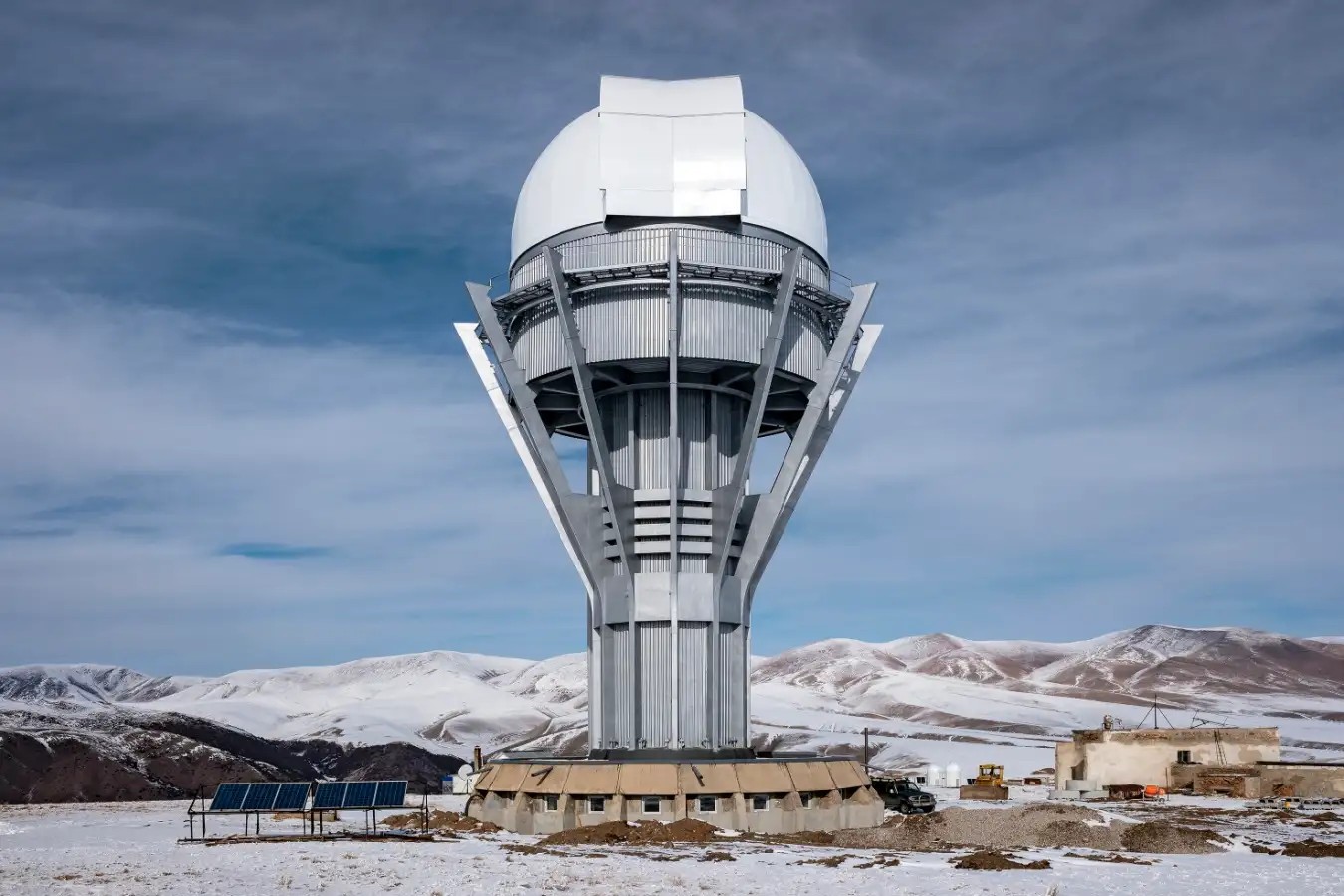
However, the story is not entirely one of decay. In Kazakhstan, Lusito found a symbol of resilience at the Assy-Turgen Observatory. The site houses the AZT-20 telescope, housed in a 45-meter-high pavilion. Construction began in the 1980s but halted with the Soviet collapse. Decades later, the project resumed in the 2010s and was completed in 2017. Today, it stands as Kazakhstan’s largest telescope and one of the most significant in the post-Soviet region.
Conclusion
Eric Lusito’s photographs offer more than just an architectural survey; they provide a visual history of an era that sought to elevate science to the status of religion. While some of these “scientific cathedrals” lie in ruins or silence due to conflict, others continue to operate, proving that the pursuit of knowledge can outlast the political systems that birthed it.