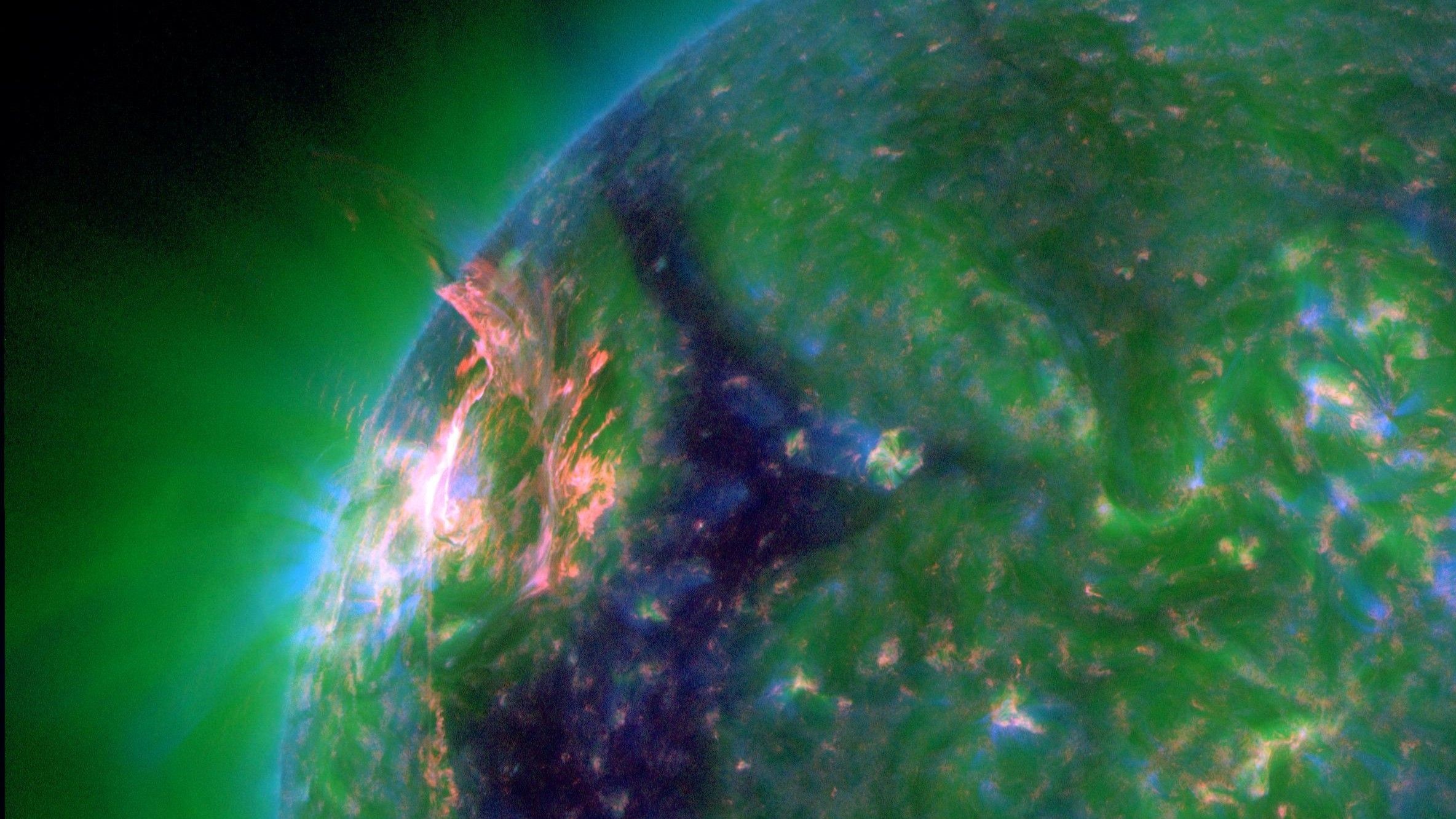
A significant solar event has torn a massive hole in the sun’s atmosphere, unleashing an M5.7-class solar flare and a cloud of charged particles that may trigger auroras on Earth. While the immediate impact was limited to brief radio disruptions, the lingering cloud of solar plasma could result in a minor geomagnetic storm, offering skywatchers in high-latitude regions a chance to see the northern lights.
The Immediate Impact: Radio Blackouts and Solar Dynamics
On Sunday, May 10, scientists at the National Oceanic and Atmospheric Administration’s (NOAA) Space Weather Prediction Center recorded an M5.7-class solar flare. This classification places the eruption in the second-strongest category, just below the most intense X-class flares.
The primary immediate effect was electromagnetic. Solar flares are sudden bursts of radiation that travel at the speed of light. Because they move so fast, they arrive at Earth almost instantly after being observed. While Earth’s magnetic field and atmosphere shield us from harmful radiation, the intense energy from this flare caused temporary radio blackouts on the sunlit side of the planet. These disruptions affect high-frequency radio communications that rely on bouncing signals off the upper atmosphere.
What Is Coming Next? A “Glancing Blow”
Unlike the instantaneous radiation of a flare, the eruption also ejected a Coronal Mass Ejection (CME). This is a slower-moving cloud of solar plasma and magnetic fields. The critical question for Earth is whether this cloud will hit us directly or miss entirely.
According to NOAA modeling, the bulk of the CME material is expected to pass behind Earth’s orbit. However, officials warn that a “glancing blow” cannot be ruled out. This interaction is predicted to occur between late May 12 and the early hours of May 13.
“Modeling of the resulting CME indicates that a bulk of the material should pass well behind Earth’s orbit… a glancing blow and or shock arrival by late on 12 May into the early portions of the 13th … can not be ruled out.”
— NOAA Space Weather Prediction Center Spokesperson
Will We See Auroras?
If the CME makes contact, it is expected to generate a G1-class geomagnetic storm. On the five-point geomagnetic storm scale (G1 to G5), G1 is considered minor. However, “minor” does not mean “invisible.”
- Aurora Visibility: G1 storms can produce visible auroras in high-latitude areas, such as northern Michigan, Maine, and parts of Canada and Scandinavia.
- Infrastructure Impact: The storm may cause weak fluctuations in power grids and minor impacts on satellite operations. It can also subtly affect migratory animals that navigate using Earth’s magnetic field.
The visual spectacle occurs when charged particles from the sun collide with gases in Earth’s upper atmosphere. Oxygen produces green and red lights, while nitrogen creates blue and purple hues, according to NASA’s Jet Propulsion Laboratory.
Context: A Sun in Transition
This event occurs against the backdrop of a highly active solar cycle. The sun operates on an approximately 11-year cycle of activity, with peaks known as “solar maximum.” The current cycle likely reached its peak in early 2025. Although theoretical models suggest solar activity is now declining, the sun remains energetic.
The source of this recent flare was Sunspot 4436, a region of intense magnetic activity. This sunspot has been particularly volatile; reports indicate it ejected at least five CMEs last week while on the far side of the sun. As long as active sunspots remain facing Earth, the potential for further flares and geomagnetic storms persists.
Conclusion
While the recent M5.7 flare caused only minor communication disruptions, the associated coronal mass ejection presents a realistic opportunity for aurora viewing in northern regions later this week. As the sun transitions out of its peak activity phase, these events serve as a reminder that our star remains a dynamic force capable of directly influencing Earth’s environment.