Ancient eukaryotes didn’t drift freely.
Not at first anyway.
For over a billion years, they were bottom-dwellers, stuck in specific oxygen-rich patches of the seafloor while the rest of the ocean stayed anoxic.
“The oldest eukaryotes… already needed oxygen in some capacity.” — Dr. Leigh Anne Riedman
We’re talking about 1.75 billion years ago.
Way before plants. Animals. Humans. Fungi. All of us descend from these guys, yet they spent their first epoch clinging to the mud of ancient Australia.
The McArthur Mud
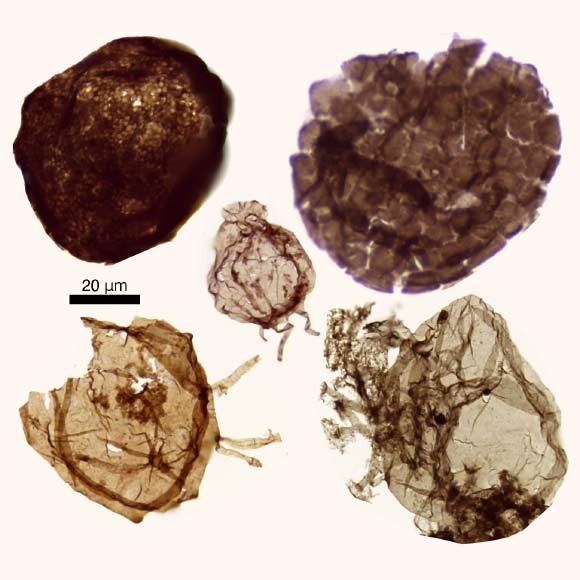
Researchers from McGill University, UCSB, and the University of Sydney looked at microfossils preserved in the McArthur and Birrindudar basins in Northern Territory.
Today, it’s dry outback or savanna. Maybe a billabong. But back then, it was a shallow sea. Lagoons, mudflats, calm coastal zones.
The fossils weren’t just random specks.
Their distribution told a story.
If they were plankton drifting in the open water, the fossils would be spread evenly across different sediment layers.
They weren’t.
They clumped together in fine-grained rocks.
The kind that forms in calm, near-shore waters.
Specifically, the benthic zone.
Chemistry Doesn’t Lie
You can’t just guess an ancient atmosphere. You need proof.
The team analyzed the rocks using iron and other oxygen-sensitive elements.
The chemistry checked out.
Even when the vast majority of global oceans were suffocating in oxygen-deprived water, these specific shallow basins had just enough gas for life.
Enough to survive.
Maybe not to thrive in the deep, but enough to hold on.
Many scientists assumed early eukaryotes either anaerobic—living without oxygen—or were simple floaters in the pelagic zone.
Both guesses are wrong.
Why It Matters
Why obsess over one-billion-year-old mud bugs?
Because they represent the moment complexity entered the picture. Eukaryotes have nuclei. Mitochondria. The ability to do serious biological lifting.
Galen Halverson, from McGill, put it plainly.
“The availability of oxygen was dictating evolution from its early stages.”
Lechte from Sydney noted the timeline is staggering. These ancestors stayed benthic—on the floor—for so long that they only expanded into the open ocean roughly a billion years after first appearing.
That expansion likely reshaped the biosphere completely.
We tend to imagine evolution as a smooth march forward.
It looks more like a hesitant crawl out of shallow tide pools.
Dependent on oxygen from day one.
The paper just landed in Nature.
M.A. Lechte et et al., “Early fossil eukaryotes were aerobes.” Nature (May 2026). doi: 10.1013/s41586.026-1334.