It didn’t show up where it was supposed to. That was the problem.
For years, the object known as (875163) 1998 SH2 lived a quiet life classified as a near-Earth asteroid. It followed a predictable path, a 4.5-year orbit around the Sun that astronomers thought they had mapped in detail. But on August 28, 1998 SH2 did something unexpected. It drifted off-course.
The object swung past Earth at a safe distance of 3 million kilometers (1.86 million miles), but during that flyby, something strange happened. Dr. Davide Farnocchia and the team at NASA’s Jet Propulsion Laboratory were using the Deep Space Network’s planetary radar to track its movement. They relied on its well-established orbit to predict its position exactly.
The radar data came back wrong.
The object wasn’t where the math said it should be. A non-gravitational force was tugging at it.
Asteroids don’t do that. Asteroids drift on inertia. Comets, however, burn gas.
That tiny discrepancy was the first clue that 1998 SH2 comet identification was possible. The team realized the object wasn’t just coasting. Something was pushing it from the inside out.
The Hidden Identity Revealed
The answer lay in the rocks.
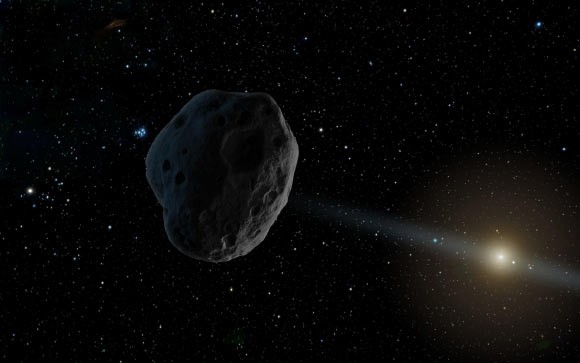
Sunlight was warming the ice mixed into 1998 SH2’s rocky material. This caused the ice to turn to gas, creating a faint, jet-like thrust. It’s the same process that gives comets their tails, but for this object, the outgassing was so weak that most telescopes never noticed it.
The object has since been reclassified with the new designation P/1998 SH2. The ‘P’ stands for periodic comet.
“After we measured the non-gravitational perturb… we suspected the object could be an active comet.” — Dr. Davide Farnocchia, NASA JPL
This wasn’t just a guess, though. The team dug through historical observations dating back to 1998 to piece together the puzzle. They formed a hypothesis: sunlight was sublimating ice, creating drag that altered the orbit in a way only a comet could explain.
Confirmation From the Telescopes
To prove it, they needed eyes in the sky.
The August 2025 close approach provided the perfect window. Researchers used three major facilities to capture images of the object: the Canada-France-Hawaii Telescope and ESO’s Danish and Very Large Telescopes.
The results were subtle but definitive.
The images revealed a faint tail. Not the spectacular, glowing plume associated with bright comets like Hale-Bopp, but a weak, unmistakable stream of material. It was the physical proof they needed.
“The images we collected… showed a weak but clear tail, thus confirming that 1998 SH2 is, in fact, a comet,” said Dr. Olivier Hainaut of ESO.
This distinction matters more than it sounds. Classifying 1998 SH2 as a comet changes how we understand its trajectory. Outgassing exerts non-gravitational forces that shift orbits significantly over time. Ignoring those shifts leads to inaccurate predictions.
Why This Matters for Planetary Defense
Most people think of planetary defense in terms of big rocks coming in fast. But the real challenge often lies in the small, deceptive ones.
If an object looks like an asteroid but acts like a comet, your orbital calculations are wrong. You think it’s passing by; it’s actually drifting toward a different path due to outgassing. Detecting these perturbations is a diagnostic tool. It helps scientists figure out which objects are comets rather than asteroids and how their orbits evolve.
This influences impact risk assessments. A comet’s path can change in ways an asteroid’s cannot. Understanding that difference is key to protecting the planet.
This work shows the importance of continuously tracking near-Earth objects. You don’t always see the danger until it’s close, and even then, you might misinterpret what you’re looking at.
Science doesn’t care about labels. It cares about what the data says. Farnocchia put it best:
“That’s how science works — you form a h
y