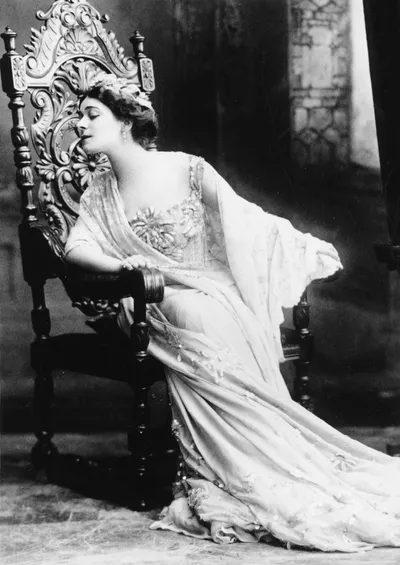
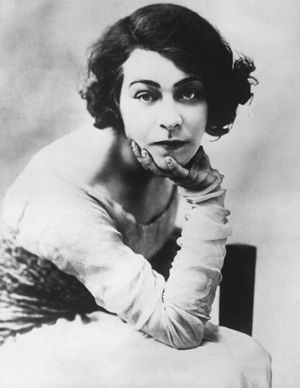
She started as a violinist. She ended up as one of Hollywood’s most enigmatic stars. Alla Nazimova didn’t just cross the Atlantic; she crossed cultures, languages, and eras to become a defining force in early 20th-century entertainment.
Born Alla Leventon in Yalta, Crimea, in 1879, she was steeped in the Russian Empire’s artistic elite. By 17, she walked away from her violin training. The stage called louder. She moved to Moscow, immersing herself in the revolutionary work of V.I. Nemirovich-Danchenko and Konstantin Stanislavsky. The Moscow Art Theatre became her classroom. But the provincial tour circuits and the Paul Orleneff Company in St. Petersburg offered her the real grind.
Then came 1905. The United States.
Here is the kicker: Nazimova spoke zero English.
She walked into the Shubert brothers’ orbit and charmed them anyway. They made a deal. Learn the language in six months, or go home. She learned. She opened in Hedda Gabler on November 13, 1906. Around this time, she shed Leventon for Nazimova—a name that sounded exotic, European, and expensive.
The Ibsen Queen on Broadway
Her breakthrough wasn’t luck. It was intensity. Nazimova didn’t just act; she inhabited her characters. Over the next two years, she became synonymous with Henrik Ibsen’s troubled heroines.
- A Doll’s House as Nora.
- The Wild Duck as Hedwig.
- The Master Builder as Hilda.
The audience ate it up. The Shuberts were so convinced of her drawing power that they commissioned a custom venue. On April 18, 1910, the Nazimova Theatre opened its doors. She played Rita Allmers in Little Eyolf. She had her own theater.
Hollywood’s Exotic Export
Success in New York usually means retirement. For Nazimova, it meant Hollywood. Between 1915 and 1925, she appeared in 17 films. It was a mixed bag.
Some were potboilers. War Brides (1916). Heart of a Child (1920). These were cash-grabs designed to capitalize on her fame rather than challenge her talent. But she also brought her stage prestige to the silver screen.
Her most notable silent-era work includes the 1921 romantic drama Camille, starring alongside the era’s biggest heartthrob, Rudolph Valentino. Then there was Salomé (1922). An adaptation of Oscar Wilde’s play, it was lavish, controversial, and visually stunning. Nazimova didn’t just star in it. She co-directed it with Charles Bryant. She controlled the narrative.
Return to the Stage and Later Years
Hollywood didn’t hold her forever. In 1928, she returned to New York. She played Madame Ranevsky in Eva Le Gallienne’s production of Anton Chekhov’s The Cherry Orchard. She became a U.S. citizen in 1927, cementing her place in American culture.
Her stage career didn’t fade. She created original roles in Eugene O’Neill’s Mourning Becomes Electra (1931) and Pearl Buck’s The Good Earth (1932). She revived Ibsen’s Ghosts in 1935 and Hedda Gabler in 1936. Critics loved it. Audiences flocked to see the woman who could make a century-old play feel urgent.
By her 60s, she was back in Hollywood for a second act. Yet, the industry hadn’t changed its mind about her type.
Nazimova was widely regarded as the foremost interpreter of Ibsen’s heroines. But her look—exotic