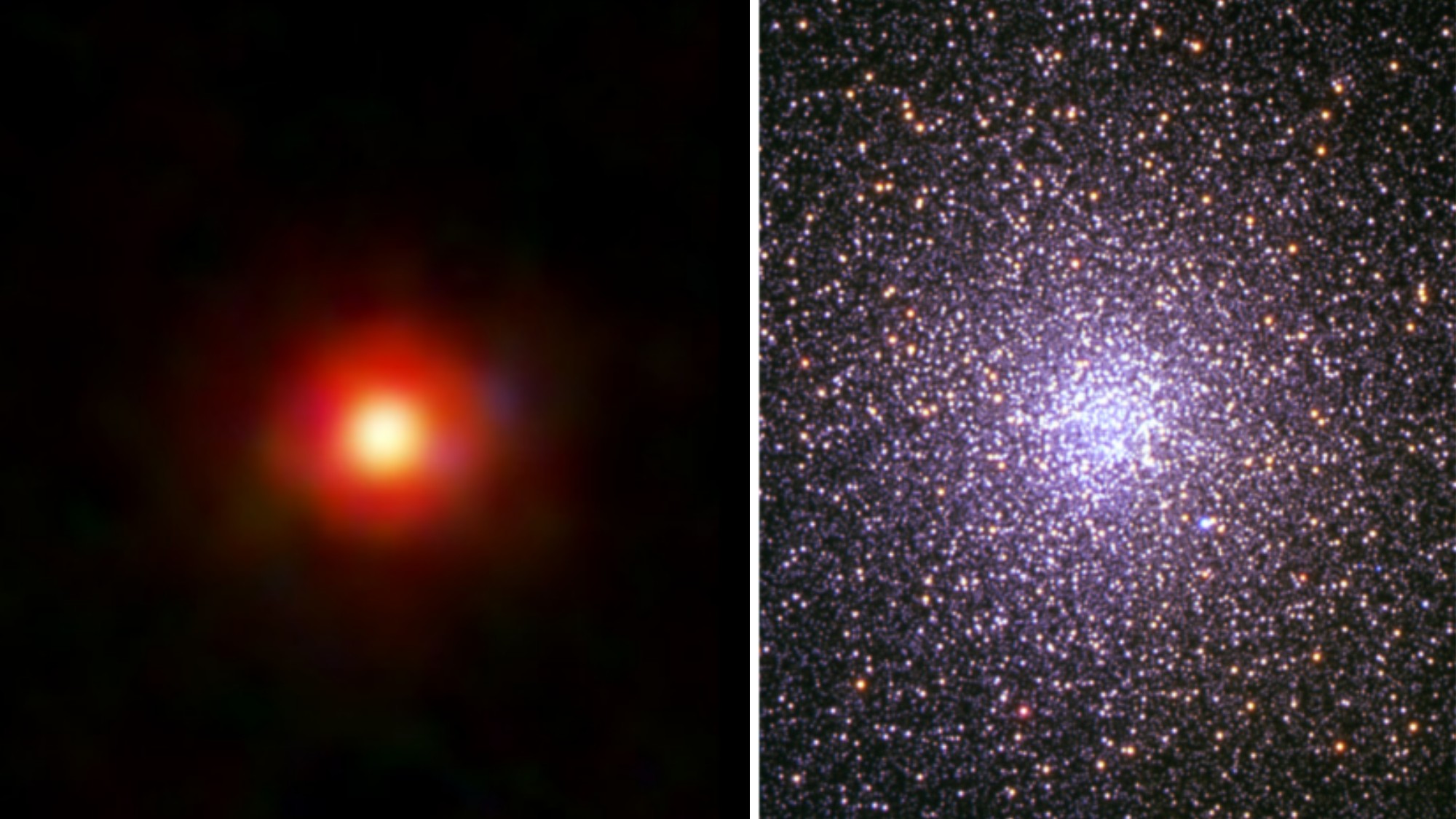
Paleontologists have long accepted that dinosaurs didn’t vanish. They evolved. Modern birds are their living descendants. Now, astronomers looking back through the James Webb Space Telescope see something similar happening in the deep cosmos. The famous “Little Red Dots” may not be extinct relics of the early universe. Instead, they might be the embryonic forms of something we see today. Specifically, vast, densely packed star groups called globular clusters.
It was 2022 when these objects became a genuine headache for researchers. The telescope started spotting them in abundance. They popped up around 600 million years afterthe Big Bang. Then, they just… stopped appearing. By the time the universe hit 2 billion years of age, they were gone. Poof.
Why do they disappear? And what are they?
For a while, the leading theory involved “black hole stars.” The idea was that these were black holes shrouded in thick gas and dust. But a new paper from the University of Texas at Austin suggests a different evolutionary path. What if these red dots aren’t dead ends? What if they are the factories building the first globular clusters?
The Supermassive Star Connection
John Chisholm, the team leader, puts it simply. These might not be strange anomalies with no connection to the present.
“Instead, Little Red Dots may persistpast the early universe, evolving into something relatively Familiar.”
The mechanism is specific. A forming globular cluster needs a heart. The team proposes this heart is a “supermassive star.” Hypothetically, these are short-lived stellar bodies. They pack 1,000 to 10,00 times the mass of our Sun into one space. At its core, a Little Red Dot might just be one of these monsters burning bright and hot.
But why does this matter? Because it explains a chemical puzzle that has baffled scientists for decades.
Look at a globular cluster in our Milky Way. There are at least 150 of them. We usually see them only after billions of years have passed. By then, the massive stars are dead. The gas is gone. Dynamical processes have scrambled their structure. It is hard to reconstruct how they started.
Yet, the stars inside are strange. They are heavy with helium, nitrogen, sodium, and aluminum. They lack the carbon, oxygen, and magnesium you’d expect from primordial gas (which started as just hydrogen and helium).
Mike Boylan-Kolchin, another team member, points to the heat required.
“This specific pattern indicates nuclear fusion at very hightemperatures, much higher than in thecores of even massive normal stars.”
Normal stars can’t cook that hard. Not that way.
Supermassive stars, however, can. They form in the dense, chaotic environments of early globular clusters. Stars collide and merge over and over. The resulting beast is hot enough to create that specific chemical fingerprint. But they don’t last. A supermassive star lives for maybe a million years. For reference, our Sun is 4.6 billion. It’s a blink of an eye.
When that star dies—in a supernova explosion—it blasts those forged elements into space. The next generation of stars inherits this weird chemistry. This is why modern globular clusters look the way they do.
Timing and Mass
There’s more than chemistry linking them. There is timing.
Little Red Dots appear when the universe is 600 million years old. That is exactly when scientists estimate globular clusters should have begun forming. The distribution also matches. The early dots are where early clusters would be. And the math holds up. Models of how a Little Red Dot evolves show its mass could easily shrink or transform into the mass of a modern globular cluster.
Chisholm notes the lifecycle is brief for the “dot” part.
“In our model, the supermassive star… would live for only a shorttime. Once that star dies, the object mayno longer look like a Little RedDot, even if thecluster itself survivesbillions of years.”
So, the dot disappears because its defining feature dies. The cluster remains.
Boyln-Kolchin is careful to note this isn’t proof. Not yet.
“There’s no single smoking gun atthispoint that says Little RedDots areglobular clusters, butitwouldexplain a lot ofdiverse and surprisingobservations.”
Still, the fit is tight. It solves the disappearance. It explains the chemistry. It aligns the timeline.
The universe is messy. Objects change. What looks like a temporary glitch in the early data might just be a growing phase of something permanent. We are used to seeing globular clusters as static, ancient relics. Maybe they were never static. Maybe they were always changing, watching from the infrared dark, waiting to be understood.