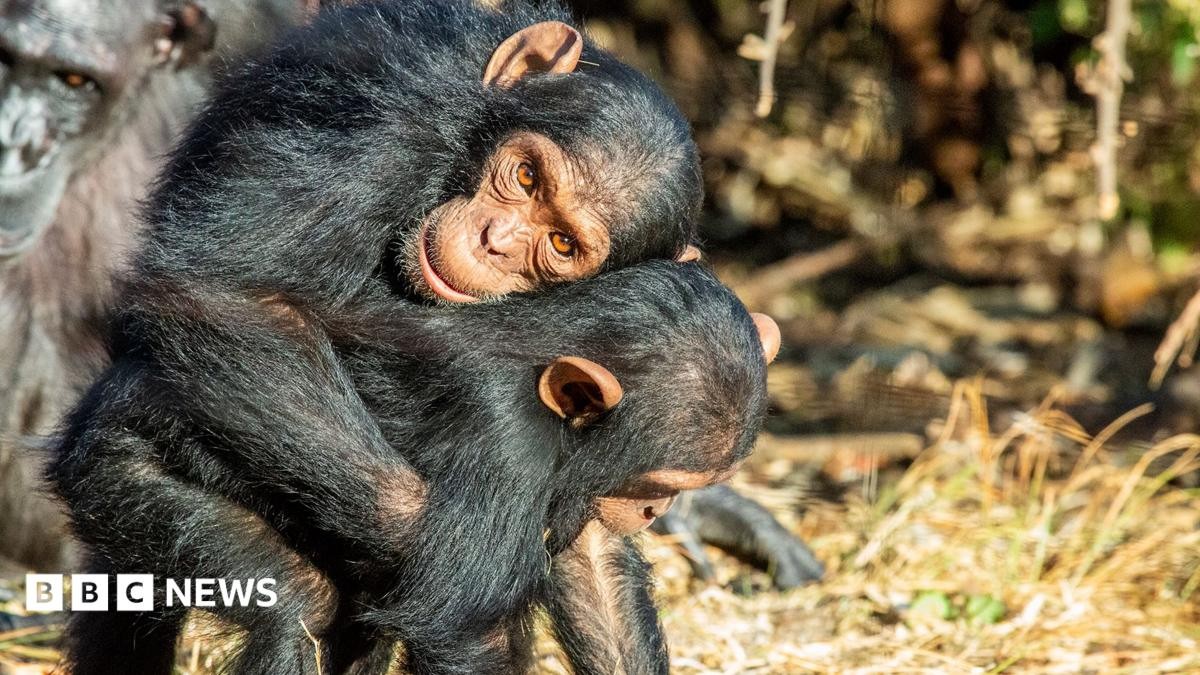
Humans often cling to each other when things get rough. Great apes do the same. New research indicates that physical affection—hugs, kisses, gentle touches—serves as an ancient mechanism for building trust. It is not just soft behavior. It is strategy.
Scientists at Durham University observed chimpanzees and bonobos in the Democratic Republic of of Congo and Zambia. The goal? To understand why these primates use physical contact to reassure one another. They looked specifically at the moments leading up to conflicts. Usually over food.
The results challenged a common stereotype. People think of chimpanzees as purely aggressive. That is wrong. The study found chimps engage in close, intimate contact before stressful events. They put fingers in each other’s mouths. They hug. They lean in.
“It’s like a ‘we’ rather than a ‘me’,” Prof Zanna Clay explained. She calls the behavior a “rallying cry.” Think of a football team huddling up before a championship game. The stress is high. The stakes are real. But the group stands together.
To see this in action, researchers set up a specific scenario. They mimicked natural feeding in the wild. They used peanuts. It is a simple treat. But in a captive environment, food can trigger tension. The apes knew the peanuts were coming. They prepared for it. And they reached out to their peers.
How do great apes keep the peace?
You might ask: why does this matter? Because it changes how we view primate social structures. We often project human politics onto animals. But this suggests something deeper. Something older. The urge to touch. To connect. To calm the nervous system before a confrontation.
The study focused on two types of great apes. Chimpanzees. Bonobos. Both are our closest relatives. Both live in complex societies. The researchers watched them interact in two different sanctuaries. This setup allowed for a naturalistic observation. It avoided the artificial constraints of a lab.
The behavior was consistent. Before a potentially conflict-ridden event. Before the food arrived. The apes came together. They reassured each other. They touched. They hugged. It was a collective effort to manage stress. Not an individual one.
The science behind primate affection
What makes this finding surprising is the nature of the contact. It wasn’t just a pat on