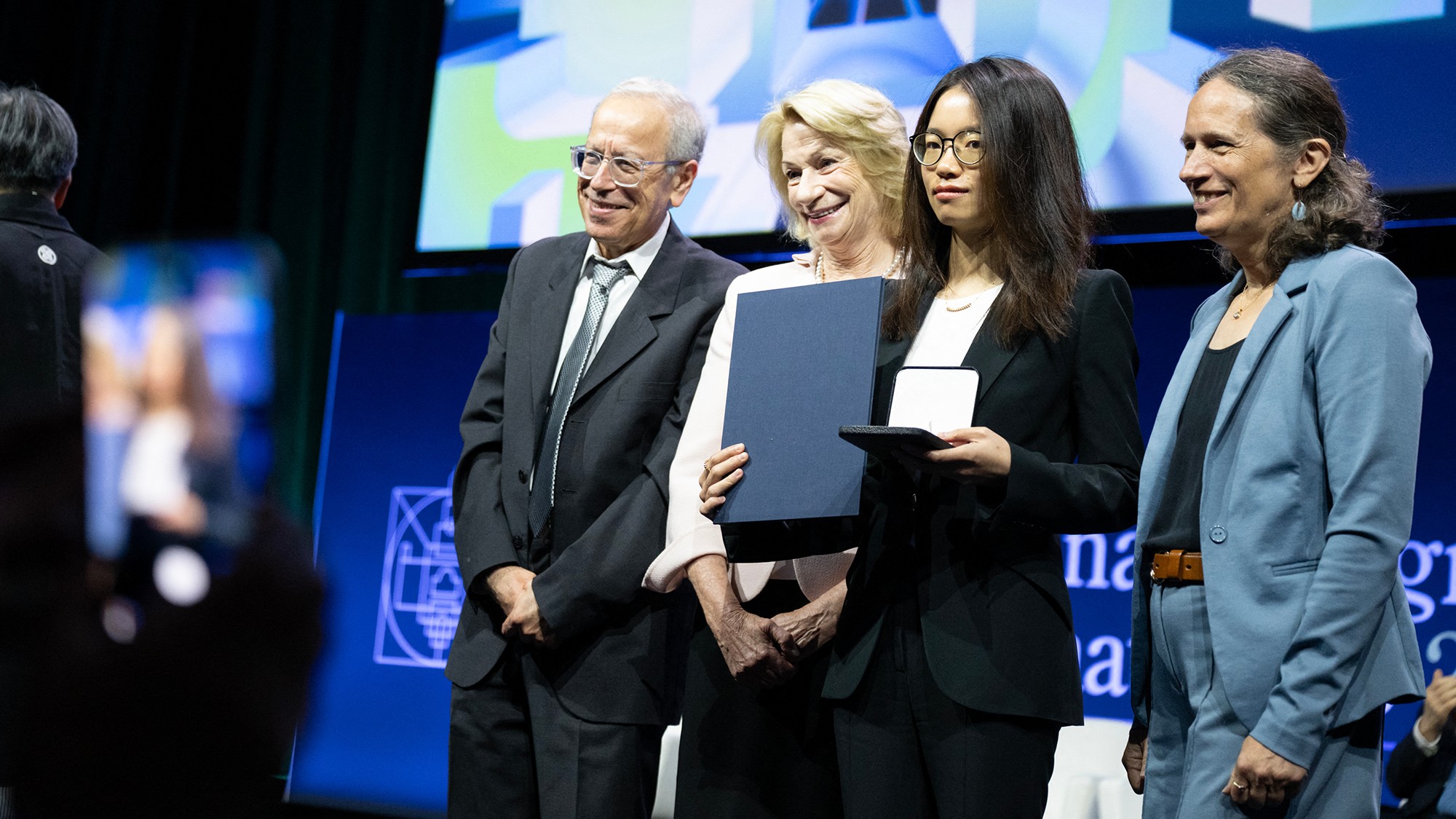
The 2026 Fields Medal was handed out this past Thursday, July 23. Four winners. One of them is Hong Wang. She’s a professor at New York University. And she just made history.
Wang is the third woman to ever take home the prize. The medal is nearly 90 years old. It’s often called the Nobel of math. But women have been conspicuously absent for most of that time. Before Wang, only two others had won.
The International Mathematical Union dropped the names. They cited Wang for solving the Kakeya needle conjecture. A decades-old puzzle. A problem that had stumped researchers for roughly 50 years.
It turns out rotating a needle in 3D space is harder than it looks.
How did Hong Wang solve the Kakeya conjecture?
The question is simple. How much room do you need to turn a needle so it points in every possible direction? Imagine a stick in a room. Spin it around. The space it sweeps out forms a shape. The conjecture asks: what’s the smallest possible shape?
For half a century, mathematicians chased the answer. They got stuck on the boundaries.
Wang, along with collaborator Joshua Zahl, cut through the noise. They treated every possible direction the needle could point to as a bundle of thin tubes. Think of it like a forest of microscopic pipes.
The trick? Finding the precise trade-off.
How thin can those tubes get? How much total space do they actually occupy? Wang used tools from harmonic analysis. That’s the branch of math that breaks complex signals or shapes down into simpler, basic components. By mapping the needle’s movement to these tube bundles, she found the limit.
Her proof is 127 pages long. She and Zahl didn’t just publish it. They checked it for months. Wang admitted she worried the argument might still be unclear. She was worried about the clarity. Not the correctness.
The math community disagreed about the worry.
“A once-in-a-century result” — Quanta Magazine
It wasn’t a clean, triumphant moment. Not immediately. It was months of silence. Then, the paper landed. It set off a string of honors. All leading here. To this medal.
The other 2026 Fields Medalists
Wang isn’t alone. The UNIU selected three other recipients under age 40.
Yu Deng from the University of Chicago. He connected the dots between microscopic and macroscopic views of gases. Bridging the tiny scale to the visible world.
John Pardon at Stony Brook University. His work solved major problems in topology and geometry. Shapes. Curves. The fundamental structures of space.
Jacob Tsimerman at the University of Toronto. He developed new techniques in algebraic geometry. Tools that have pushed progress on other long-standing puzzles forward.
Four winners. Four very different approaches. All recognized for outstanding discoveries.
Why this matters for women in math
The gender gap in this award is stark. And recent.
Maryam Mirzakhani of Iran broke the barrier in 2014. First woman to win.
Maryna Viazovska from Ukraine followed in 2022.
That’s it.
For nearly 80 years, no woman received the Fields Medal at all. Mirzakhani’s win in 2014 shattered that. Viazovska proved it wasn’t a fluke. Wang’s selection in 2026 cements it. Three women in 35 years.
Before 2014? Zero.
It’s an exceptionally small group. But it’s a growing one. Wang’s work on the needle conjecture didn’t just solve a puzzle. It forced the field to look at the problem differently. Using harmonic analysis on geometric structures? That’s a shift.
Is the gap closing? Or are we just seeing the tip?
Wang’s proof was complex. It required checking. It required time. It wasn’t elegant in the way of a quick trick. It was deep.
She didn’t just find the answer. She showed how the pieces fit together when no one else could see the pattern. The needle spins. The tubes bundle. The space shrinks.
We’ll see what comes next. Probably something unexpected.