Gravity acts like a lens. It bends space, twists time, and magnifies light that would otherwise remain hidden in the dark. Albert Einstein guessed this a century ago. He knew massive objects could warp the fabric of the cosmos, stretching light from distant sources as it passed by. Today, we call that phenomenon gravitational lensing. The James Webb Space Telescope (JWT) uses this predictable cosmic distortion to see the universe’s most ancient relics.
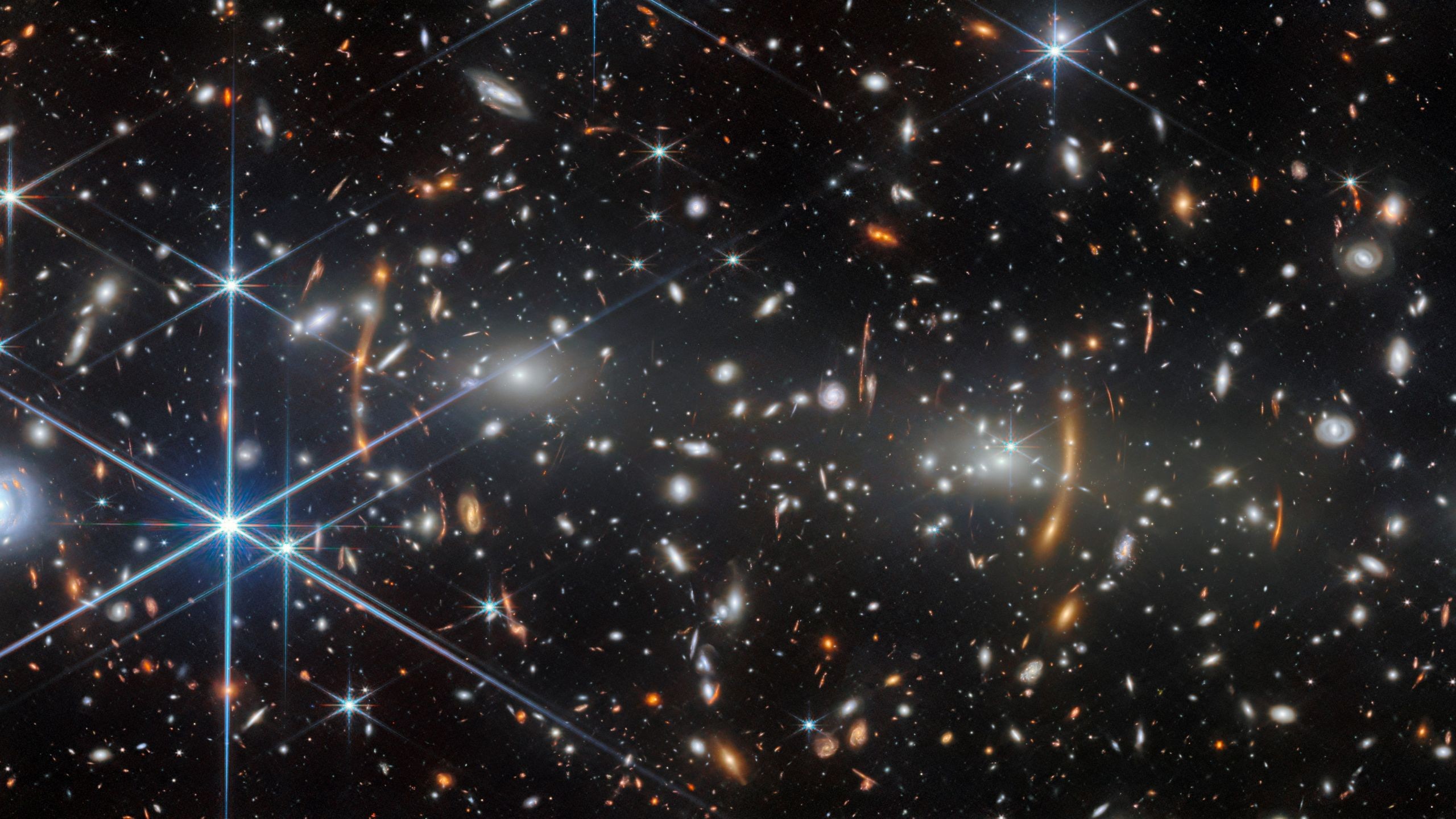
This isn’t theory anymore. It is a working tool in observatory toolboxes. Look at the latest release from JWST, centered on a chaotic young galaxy cluster known as MACS J053.4-042. Here, Einstein’s funhouse mirrors are fully at work. The image shows two massive galaxies locking horns, surrounded by a background of faint, ancient starlight amplified into visibility by the sheer weight of matter between us and the early universe.
The Collision in Columba
At the heart of the frame are two bright, white-beacon galaxies. They sit in the constellation of Columba. According to the European Space Agency ( ESA), these aren’t just floating alone. They are the gravitational centers of their own sub-clusters, wreathed in smaller, subordinate galaxies. But they aren’t at peace. They are crashing.
The light we see from this scene left when the universe was only about 9 billion years old roughly 4.4 billion years ago —not an eye-blink for cosmic evolution, but an eternity for biology. These clusters are in the middle of a messy merger. The two main elliptical galaxies have already punched through each other’s cores. Right now, they are separated by roughly 1 million light-years. Imagine lining up ten Milky Ways side-by-side. That’s the gap closing. In billions of years, they will fall back toward one another, merge completely, and become one.
The two clusters are not getting along, merging in a process that will eventually create a single, monstrous galaxy.
But look past the white centers. Look to the edges.
Seeing the Invisible With Gravitational Lensing
The real story lives in the orange arcs. These contorted ribbons of light flank the main cluster like handles on a cup. They aren’t part of the local group. They are background galaxies, vastly further away, whose light has been bent and stretched by the gravity of the foreground cluster. Without this lensing effect, those signals would be too faint for even James Webb to detect.
Gravitational lensing allows astronomers to probe galaxies formed less than a billion years afterthe Big Bang. It amplifies the faintest whispers of the early universe, turning impossible-to-see objects into clear targets for study. In the left arc of the image alone, three bright dots are not three different galaxies. They are one and the same galaxy, imaged multiple times as its light took different paths around the lens.
This isn’t a rare glitch. This distortion repeats across the field of view. Each elongated orange streak offers a warped window into an ancient era of cosmic history. It’s how scientists verify that the early universe was building stars faster than our models predicted. The oldest structures in the cosmos are larger and more mature than current theories of cosmology say they should be.
Why This Lensing Matters for Deep Field Study
Gravitational lensing is not just a pretty picture. It is the primary method for studying the faint, oldest galaxies. By using one massive cosmic oddity (a galaxy cluster) as a lens to uncover another (distant ancient galaxies), JWST fills gaps in our timeline. The mass of MACS 0453.3-3542 acts as a natural magnifying glass, allowing us to see details that would be blurred or invisible without help.
Scientists expect these observations to keep astronomers busy for years. Every new image reveals that early galaxy formation was messier, faster, and more complex than previous data suggested. We are seeing the universe in a state of rapid construction, captured in high definition by the best telescope ever built. The lens doesn’t lie. The universe was always wilder than we thought.
And that is only the beginning of what this telescope will see.