It is red, white, and blue. A lot of it.
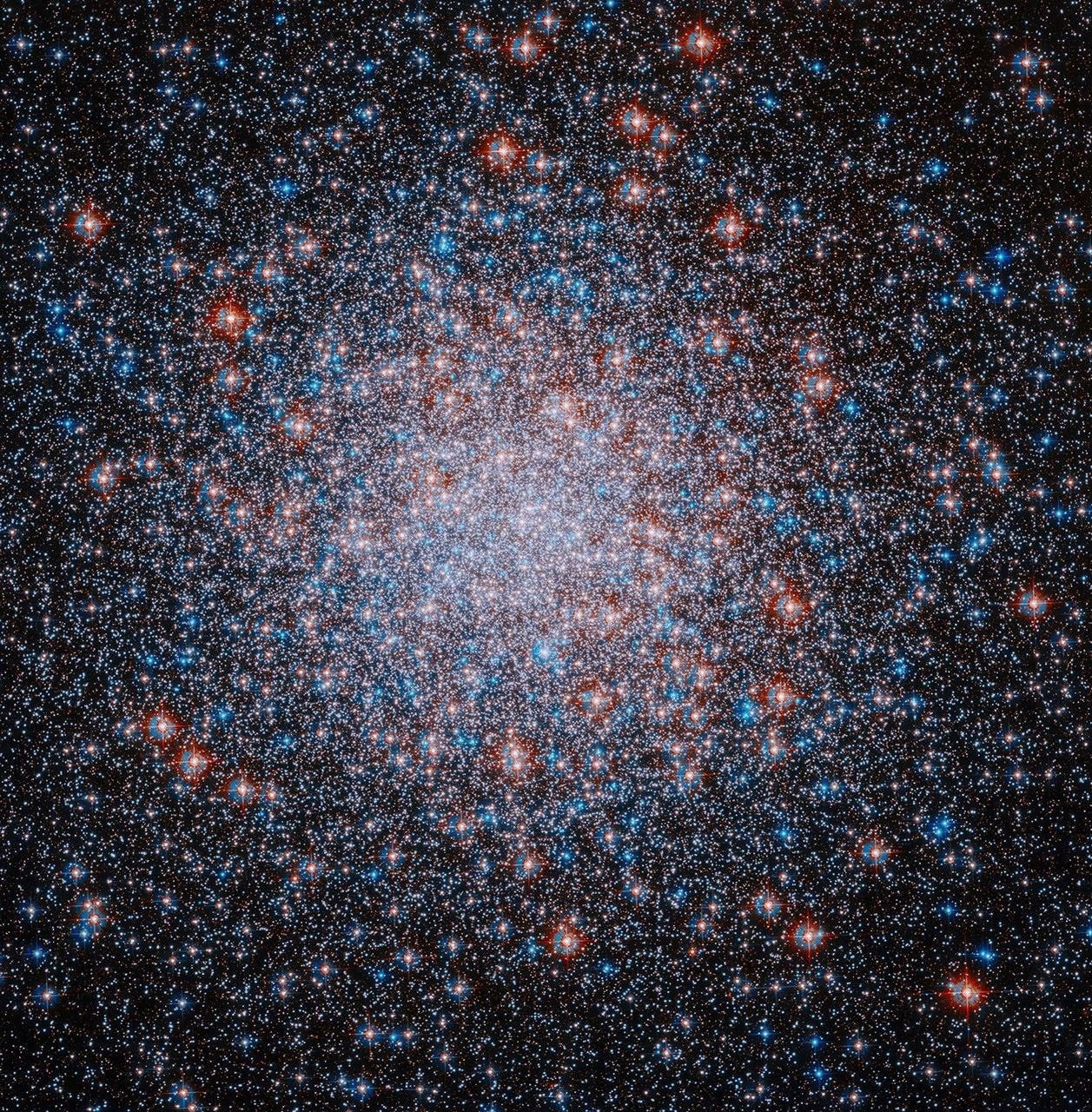
Hubble just released a picture that feels less like astronomy and more like fireworks stuck in a jar. Released for the US bicentennial, this shot features Messier 3, or M3. One of the Milky Way’s largest globular clusters, it packs more than half a million stars into a dense, gravitational hug.
They are old. Very old.
Gravity’s tight grip
Globular clusters are spherical knots of stars born from the same gas cloud. Same time, same place, same fate. Gravity keeps them glued together while they orbit the outer fringes of the galaxy. We have found about 150 of these ancient balls of light.
M3 stands out. It is huge, but its distance from the galactic center makes it special.
It also hosts a weird secret: 240+ RR Lyrae variable stars. That is the most of any known cluster in the Milky Way.
The distance trick
These stars pulse. Their brightness waxes and wanes on a strict schedule.
Astronomers love predictability. They compare the star’s true brightness with how dim it looks from Earth. Think of car headlights at night. You know how bright those beams are, so the dimmer they appear, the farther away the car must be.
Simple physics. Accurate distance.
Blue stragglers
Then there are the rebels.
M3 contains roughly 70 “blue stragglers.” These are bright, blue, and look impossibly young compared to their ancient, red neighbors. In fact, this is the very cluster where we first spotted them.
How does an ancient star get young again?
Astronomers suspect theft. Gravitational shenanigans likely pulled extra mass from a companion star onto the straggler. The added weight reheated it. Now it burns hotter, shines bluer, and lies about its age.
A cosmic cheat code.
Two in one?
The evidence suggests M3 isn’t just one thing. It might be two.
Data shows two distinct populations of stars living together. Scientists think M3 formed when two globular clusters merged. Probably siblings.
Both likely hailed from the same dwarf galaxy. A smaller galaxy that the Milky Way swallowed whole.
Reconstructing history
Hubble has been staring at M3—also known as NGC 5242—many times now. The latest image sorts the light.
Blue pixels capture shorter visible wavelengths. Red covers longer visible waves plus some near-infrared. The processing follows standard protocols. No tricks, just math translating heat to color. Blue is hot. Red is cool.
This is part of a larger plan.
Hubble’s Treasury program aims to map half of the galaxy’s known clusters. Each cluster is a time capsule. Study enough of them, and you can stitch together the timeline of our galaxy’s evolution.
After 30+ years in orbit, Hubble is still pulling its weight. Alongside Webb and the forthcoming Nancy Grace Roman telescope, it keeps building the puzzle.
We are looking at echoes of ancient collisions. Just wondering if the universe ever truly moves on. 🌌