During public talks the question always comes. Do aliens exist?
I pause. The room waits. My answer shocks people. Absolutely. I don’t even consider the other option.
As a radio astronomer this certainty feels mundane. We see the exoplanet data. Earth 2.0 isn’t a question anymore. It’s a statistical inevitability. Even if life is rare the numbers in the Milky Way drown out that rarity. We are not alone. Not even close.
I’m not talking about slime molds either. I mean intelligence. Complex minds. This is where the silence hits the audience hard.
People expect debate. They want war between science and belief. Mostly they conflate SETI with UFOs. That’s a mistake. Have aliens visited? Absolutely not. I’m sure of it too. No pyramids. No crop circles. Just Venus and bad camera focus. If UFO sightings were real smartphone ownership would have tripled them by now. It didn’t. That’s the conspiracy part. Leave it there.
SETI is different. It is rigorous. It is math and radio. We don’t wonder if. We know they are there. We just want to say hello.
The Drake signal
Frank Drake didn’t want to wait. Listening is passive. Drake wanted to shout.
In 1974 at Arecibo Observatory he launched METI. Messaging extraterrestrial intelligence. Active broadcasting.
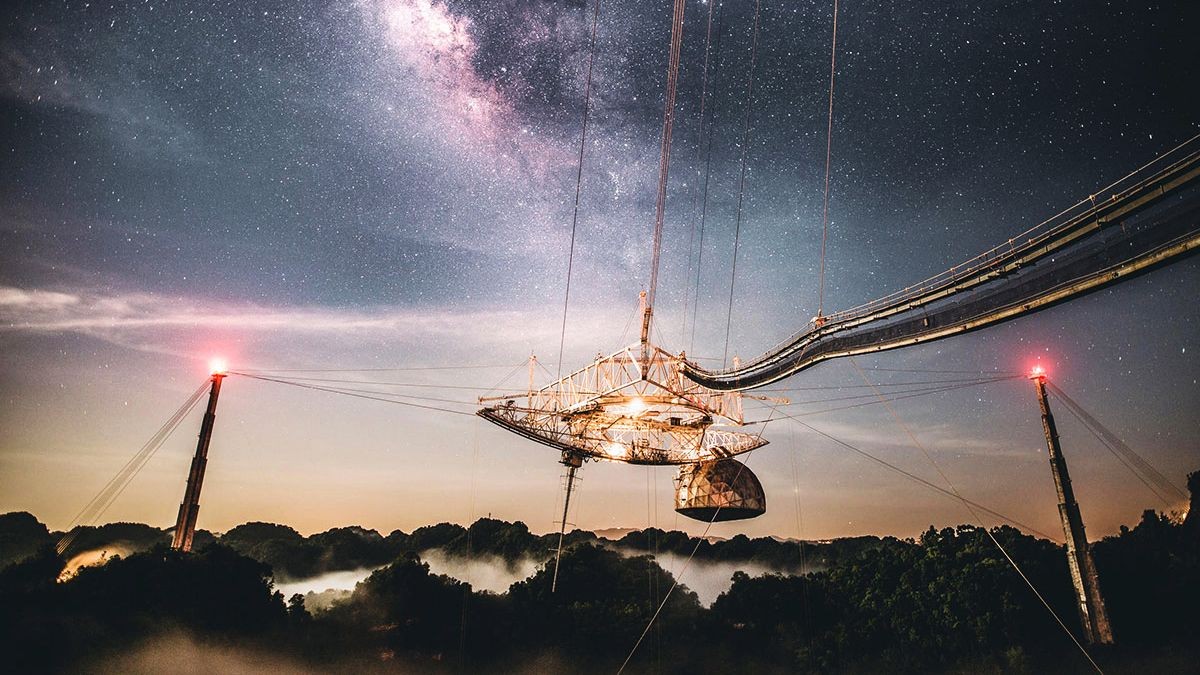
He used the big dish. 305 meters of antenna aiming at the sky during a renovation gala. The message? 1,679 bits of data. Binary.
One tone means black. Another means white. It’s essentially paint by numbers but for civilizations light-years away. The content? A human silhouette. A DNA map. Our solar system.
Drake chose 1,679 because it is a semiprime. $23 \times 73$. Only these dimensions make the image work. Any smart alien cracking that code would spot the primes. They’d reshape the data. They’d see the picture.
Three minutes long. The signal blasted out. Ten million times brighter than the Sun’s natural radio noise. For those 180 seconds we were a beacon in the dark.
I’ve listened to the audio. It’s not Mozart. It’s two tones clicking back and forth. Beep beep beep. But knowing it carries the face of our species into the cosmos? It’s heavy. Probably made someone cry in the Puerto Rican jungle.
Where did it go? M13. The Hercules constellation. 21,000-light-year target. Chosen because it was overhead that day and had lots of stars. A dense neighborhood.
Now it is awkward. By the time that radio beam hits M13 the star cluster might have moved. We aimed at a moving target and fired blind. But the signal is out there. Irreversible.
By lunchtime that day it passed Pluto. Today it sits past 51 Pegasi b. Drifting. Silent.
The hungry sky
Drake got pushback. Hard.
Sir Martin Ryle England’s Astronomer Royal hated it. He wrote to the IAU demanding a ban. His fear was simple. What if they are hungry? What if they are malevolent? Should one man decide for the whole planet?
Most of SETI rolled their eyes. The genie was already out. Radio waves leak. TV broadcasts escape. We’ve been noisy since Marconi. Whether anyone is coming depends on physics and economics.
Could they travel? Maybe. Would they spend that energy coming here? Probably not. Imagine if aliens had to build an interstellar ark right now during our energy crisis. We wouldn’t do it. Why assume they would?
Drake puts it bluntly. If they were coming to land he’d sit on his lawn chair and wait. No need for telescopes. Just watch the sky.
Contact isn’t invasion. It’s email.
Well slower email. TRAPPIST-1 is 40 light-years away. Send a hello now. Wait eighty years for the reply. That’s not a chat. It’s correspondence from your grandmother’s pen pal. Slow. Intentional. Not something that fuels daily news cycles.
We are ready for this culturally. Sci-fi primed us. Aliens are already in our living rooms on Netflix. Discovering they are real might just feel like updating the background music of the universe.
Budgets get cut. Skeptics grumble. Politicians argue. But we keep looking. Because the physics is universal.
Yellow-green skies or five moons doesn’t matter. Radio works everywhere. It is the lingua franca of long-distance communication.
Maybe right now on TRAPPIST-1 a green kid with twenty fingers turned on a new radio telescope. Maybe they just hit send. They crossed those twenty fingers hoping someone hears them.
We are tuning our dishes. Waiting. The beam could be centuries away or already here bouncing around dust.
We don’t know when the answer arrives. Or if it’s a hello at all. We just keep our eyes on the dark and listen to the static.