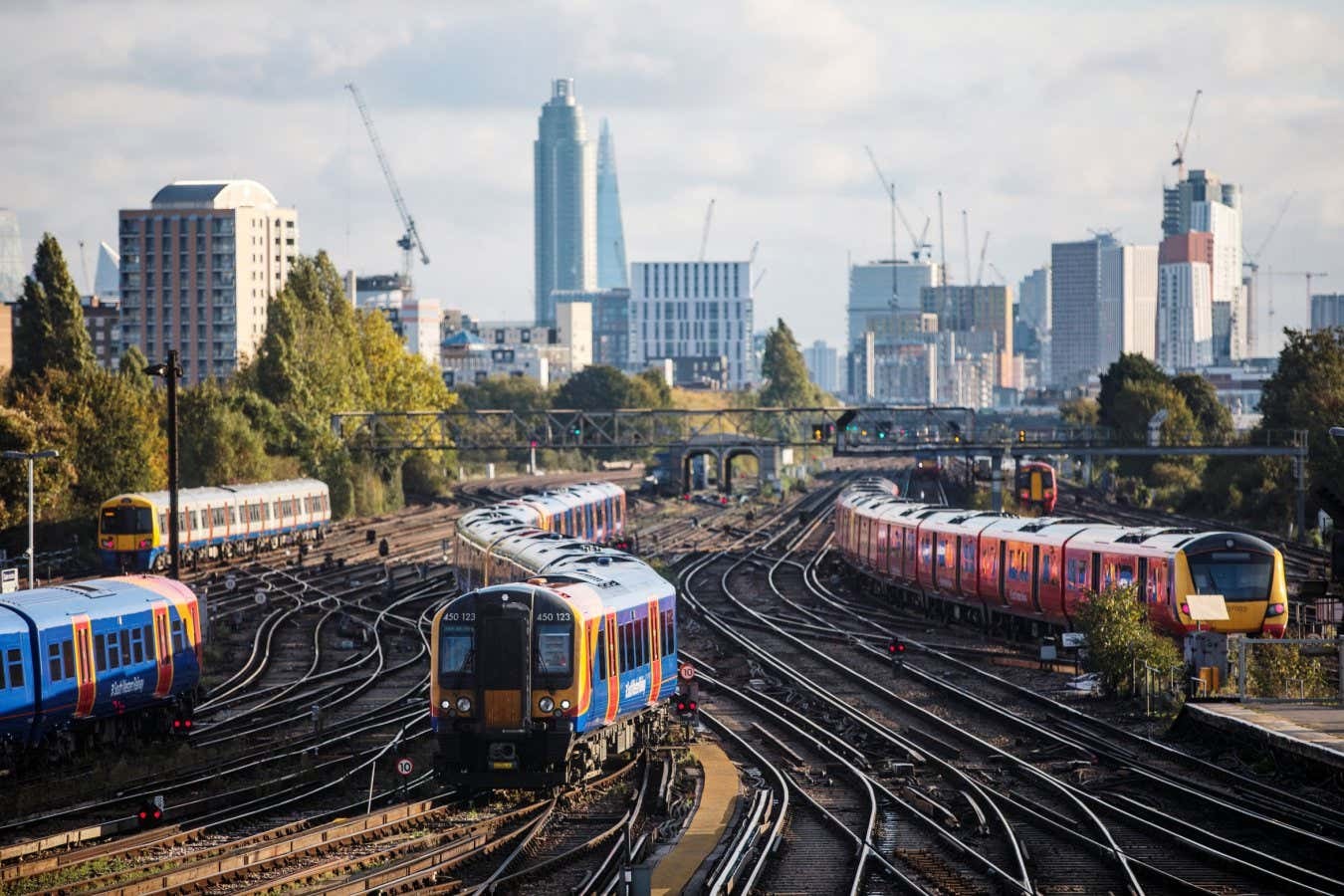
It’s a bad idea to have a green signal when it should be red.
Cameron Patterson, over at Lancaster University, says space storms can make this exact scenario happen. A lot. Electrical systems across railways in the UK and other countries are sitting out there, naked and vulnerable. The worst-case scenario isn’t just a delay. It’s a deadly crash.
“You could have disruptions to signalling systems… We have to prepare for these things now.”
The sun isn’t just light and heat. It throws charged particles at us constantly. This is the solar wind. It gives us pretty auroras. But sometimes the sun sneezes violently. Solar storms. They mess with Earth’s magnetic field. Satellites hate it, yes. But the ground isn’t immune.
A changing magnetic field induces current. Everywhere. Including your tracks.
This matters because many rail networks use direct current through the rails to “feel” where the train is. When the train rolls over, the current shifts. Simple physics. Then a solar storm hits. It injects geomagnetically induced current into the mix. The sensors get confused.
Green turns red. Red turns green.
Patterson brought this up at a meeting of the European Geosciences in Vienna. He pointed out the speed. Trains go fast. If the warning comes too late, you don’t get to brake in time. Is it paranoid to worry about space weather?
There’s precedent. July 1982 in Sweden. Signals flipped. They linked it to currents running through the track. But Patterson suspects we missed dozens more cases.
Here is why: by the time an engineer gets there to check the fault, the storm is over. Everything looks fine. They file a report for “unknown causes” and move on. Russian research has spotted the correlation. Most engineers don’t look up. They look down.
Even if you survive the red-to-green flip, the reverse is nasty. Green to red causes massive jams. Passengers might bail out of stopped trains onto active lines. That is also a disaster waiting to happen.
The probability is low, sure. Storms this strong? Maybe once every 30 years.
Patterson reminds people of a common trap: a one-in-100 year event could happen next month. It has no memory. A really big storm would bring blackouts along with it. Widespread chaos.
Not all trains use that old-fashioned track current. Some countries use magnetic sensors to count wheel revolutions. We don’t really know if those are safe from the induced currents yet. It’s an open question.
Then there is the overhead infrastructure. Transformers on electric lines. The tilting mechanism for curves. Radio comms. Satellite navigation. All of it takes a hit during severe solar weather. The web is connected, and the storm sees it all.
Patterson is working with Network Rail and safety boards in the UK now. Trying to harden the systems. Getting the conversation started was difficult, he admits. People tend to ignore things they can’t see in the sky. But now, they are listening.
Magnus Wik, at the Swedish Institute of Space Sweden, agrees with the hidden danger. The glitches are short. They vanish before anyone records why they happened.
Sweden actually tried to fix this decades ago. Back in the 50s. They modified the rail system after signals turned red-to-green during the 30s. The 1982 event was less critical because the signal turned red, causing a stop rather than a go-ahead. But Wik isn’t sure if the threat is fully understood today.
“They don’t know what caused it and have no evidence of it.”
The Swedish Transport Administration is flying blind regarding historical data. They are thinking about cross-referencing storm records with error logs. It’s not an official project yet.
We have the data. We just haven’t looked at them together. Maybe we should.