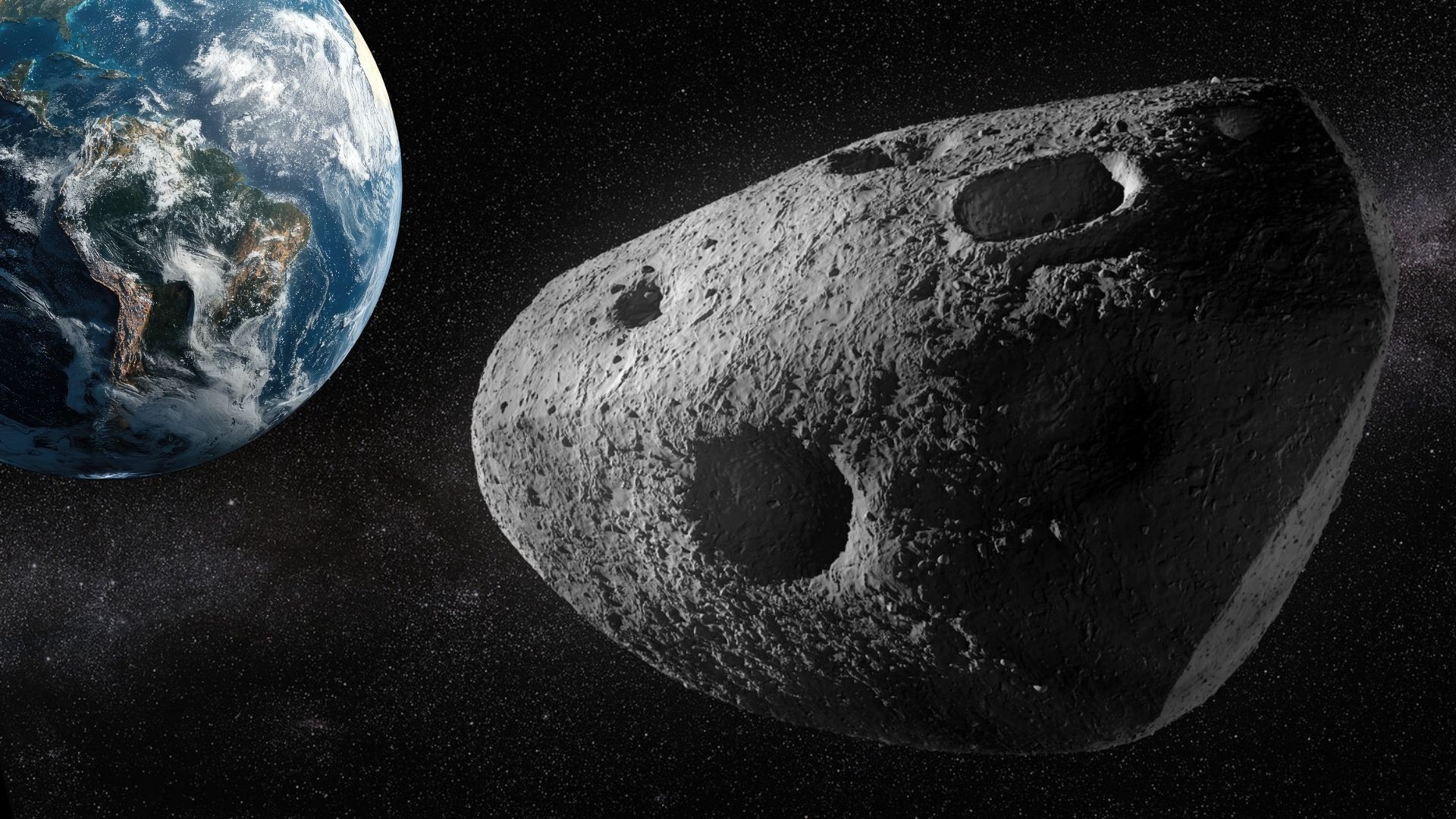
On April 13, 2029, the night sky will host a celestial spectacle rarely seen in human history. The near-Earth asteroid 9942 Apophis is set to make an extraordinarily close approach to our planet, passing so near that it will be visible to the naked eye.
This is not merely a routine astronomical transit; it is a rare encounter that offers scientists—and stargazers—a front-row seat to the raw mechanics of our solar system.
A Close Encounter: The Details
Apophis will reach its closest point to Earth at approximately 5:45 p.m. EDT (21:45 GMT) on April 13. At this moment, the asteroid will pass roughly 20,000 miles (32,000 kilometers) away from us. To put that in perspective, it will be closer to Earth than the satellites we use for global communications.
For observers in Europe, Africa, and Western Asia, the event will be particularly striking. About an hour before its closest approach, the asteroid will reach a peak brightness (magnitude 3.1), making it bright enough to spot without a telescope from dark-sky locations.
From “Doomsday” to Scientific Goldmine
When Apophis was first discovered in 2004, its name—inspired by the Ancient Egyptian deity of chaos—felt prophetic. Early calculations suggested a terrifying possibility: an impact with Earth.
However, modern radar tracking and updated observations have since ruled out any collision risk for at least the next century. While it remains classified as a “potentially hazardous asteroid” due to its size (roughly 1,230 feet or 375 meters across) and proximity, the fear of impact has been replaced by scientific excitement.
Why does this proximity matter?
The gravitational pull exerted by Earth will be so strong that it may physically alter the asteroid itself. Scientists expect to witness:
* Changes in spin rate: The “tidal pull” could alter how the asteroid rotates.
* Internal shifts: The gravity may cause seismic shaking within the asteroid’s core.
* Surface changes: The encounter could trigger massive landslides on the asteroid’s rocky surface.
The Space Race to Observe Apophis
Because this event is a unique laboratory for planetary science, several space agencies are mobilizing:
- ESA (European Space Agency): The proposed Ramses mission aims to observe the asteroid closely leading up to the flyby.
- NASA: The OSIRIS-APEX spacecraft (the successor to the OSIRIS-REx mission) is scheduled to orbit Apophis in June 2029 to study the aftermath of the Earth encounter.
- Private Sector: Companies like ExLabs are also planning commercial rendezvous missions to capture data.
Planning for the Spectacle: Astrotourism
For enthusiasts, the 2029 flyby is a primary destination for “astrotourism.” To see Apophis at its best, observers will need to seek out locations with low humidity and minimal light pollution.
Top candidates for viewing include:
* The Canary Islands (Tenerife): Renowned for high-altitude sites that sit above much of the cloud cover.
* North Africa: Regions in Mauritania and Morocco offer vast, dark skies.
* Southern Spain: A viable coastal option, though subject to more unpredictable weather.
The timing of the event is also fortuitous for stargazers: the flyby coincides with a new moon, ensuring the sky will be dark enough to see the asteroid clearly, and it occurs during the bright opposition of Jupiter.
“The Apophis flyby will be an extraordinary event… It is the first time scientists will witness an event of this kind,” notes planetary scientist Nick Moskovitz.
Conclusion
The 2029 passage of Apophis represents a rare intersection of celestial mechanics and human observation. It serves as both a profound scientific opportunity to understand asteroid evolution and a breathtaking visual event for anyone lucky enough to be under a clear sky.