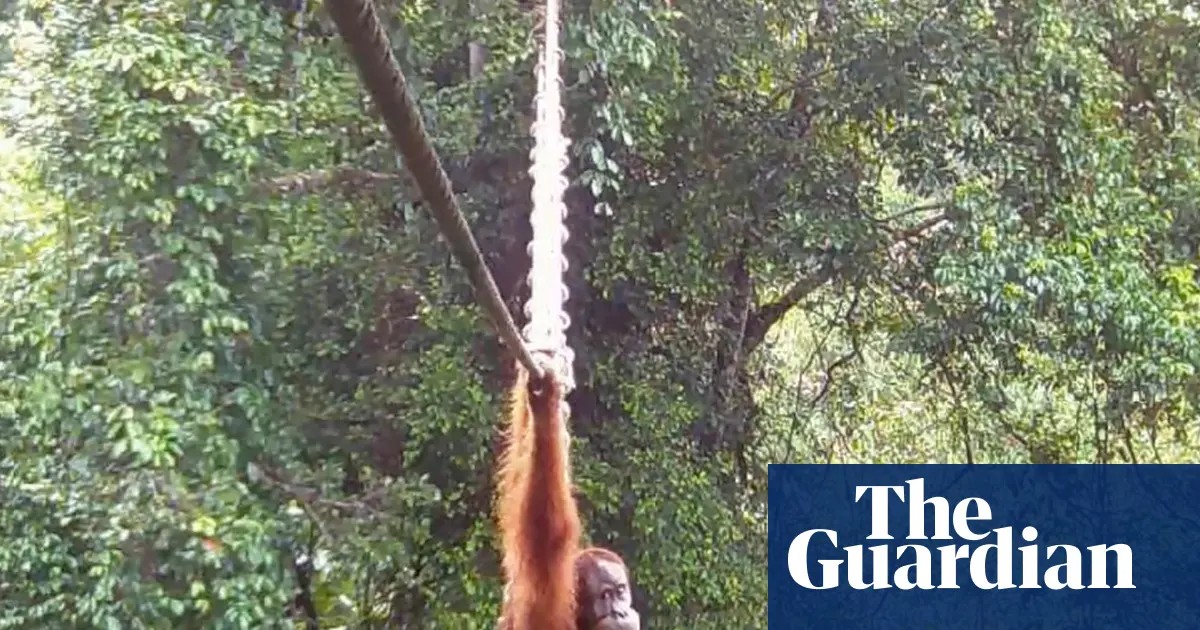
In a moment of profound relief for conservationists, footage has emerged showing a critically endangered Sumatran orangutan successfully using a newly constructed canopy bridge to cross a major road. This milestone marks the first time the species has been captured on camera using such a structure, proving that man-made infrastructure can coexist with wildlife corridors.
Breaking the Barrier
For years, the Lagan-Pagindar road in Indonesia’s Pakpak Bharat district served as a physical barrier for local wildlife. While the road is a vital artery for human transport, it effectively sliced through the natural habitat of the region’s orangutans.
To remedy this, the environmental organization Tangguh Hutan Khatulistiwa (TaHuKah) and the Sumatran Orangutan Society (SOS) collaborated to build a high-altitude canopy bridge. The goal was to reconnect fragmented forest patches, allowing animals to move freely without descending to the dangerous road level.
Why This Crossing Matters
The success of this crossing is more than just a heartwarming video; it is a critical win for the long-term survival of the species. The road had split a local population of approximately 350 orangutans into two isolated groups: one in the Siranggas wildlife reserve and another in the Sikulaping protection forest.
This isolation poses a severe biological threat known as a genetic bottleneck :
– Inbreeding Risks: When populations are sequestered in small pockets, they are forced to mate within a limited gene pool.
– Functional Extinction: Over time, this leads to weakened health and reduced fertility, meaning a species might still exist in number but is biologically doomed to vanish.
– Habitat Connectivity: As the world’s largest arboreal (tree-dwelling) mammals, orangutans rely on the forest canopy for over 90% of their lives. A bridge restores their ability to navigate their natural “highways.”
A Test of Patience and Intelligence
The bridge was installed in 2024, but the breakthrough did not come immediately. While other species—including black giant squirrels, macaques, and gibbons—began using the bridge shortly after its construction, the orangutans remained elusive.
Conservationists spent two years monitoring camera traps, waiting for evidence that the primates had discovered or felt safe enough to use the structure. The footage finally captured a young male orangutan tentatively stepping onto the bridge, pausing mid-way to inspect the road below, and then confidently proceeding into the Sikulaping protection forest.
Modernization vs. Conservation
The project serves as a successful case study in balancing human development with ecological preservation. By working with local government, conservationists demonstrated that infrastructure does not have to result in habitat destruction.
“Witnessing a Sumatran orangutan confidently crossing that bridge is living proof that we need not sever the forest’s lifeline in order to build our communities’ own,” said Franc Bernhard Tumanggor, head of the Pakpak Bharat district.
With only an estimated 14,000 Sumatran orangutans remaining in the wild, every successful connection between forest fragments provides a vital opportunity for the species to thrive and maintain genetic diversity.
Conclusion: The successful use of the canopy bridge proves that strategic wildlife corridors can mitigate the damage caused by human infrastructure, offering a vital lifeline to help prevent the genetic decline of the Sumatran orangutan.