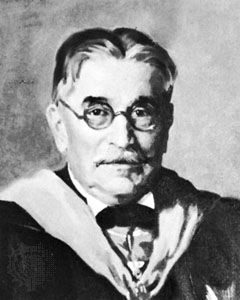
He was born in 1854 in what is now Serbia, but his real impact was felt on the other side of the Atlantic. Mihajlo Pupin was a physicist who figured out how to make the telephone work over long distances. Before his invention, calls beyond a few dozen miles were garbled messes of static or silence. Pupin found a way to extend that range significantly. He didn’t just tweak the technology. He fundamentally changed how signals traveled through wire.
Pupin’s early life wasn’t a straight line to success. His parents were illiterate Serbian immigrants who still pushed him to learn. He arrived in the United States in 1874. The first years were rough. He took odd jobs to survive before he could even think about higher education. Eventually, he enrolled at Columbia College, now Columbia University. He earned his bachelor’s degree in 1883. That same year, he became a U.S. citizen.
Education didn’t stop there. He moved to Europe to study at the University of Cambridge and the University of Berlin. He returned with a Ph.D. in 1889. He started teaching mathematical physics at Columbia shortly after. He stayed there for decades, eventually becoming professor emeritus in 1931.
His scientific contributions were broad. In 1896, he discovered that atoms struck by X-rays emit secondary X-ray radiation. This was a key insight into how matter interacts with high-energy light. He also invented a method for taking short-exposure X-ray photographs. This allowed doctors and researchers to capture clearer images without the subject moving.
But the invention that changed everyday life was the loading coil.
Telephone companies struggled with signal degradation. High-frequency signals died out quickly in copper wires. Pupin realized that inserting coils of wire at specific intervals along the line could counteract this loss. These loading coils preserved the strength of the voice signal. They allowed clear conversation over much longer distances. Without this breakthrough, the early telephone network would have remained a local novelty rather than a global utility.
The technology was too valuable to ignore. In 1901, the American Telephone and Telegraph Co. (AT&T) and several German telephone interests acquired the patent for Pupin’s invention. The deal secured the future of long-distance communication infrastructure. It turned the telephone into a serious tool for business and personal connection across continents.
Pupin didn’t just invent hardware. He also documented his journey. He wrote an autobiography titled From Immigrant to Inventor, published in 1923. The book detailed his rise from a poor immigrant to a respected scientist. Critics recognized the work’s quality. He won the Pulitzer Prize in biography in 1924 for this very book.
He died in New York on March 12, 1935. His legacy isn’t just in the coils or the patents. It’s in the fact that we now expect to talk to anyone, anywhere, without the line dropping. The infrastructure he helped build still underpins our connected world.
Did he anticipate how central long-distance calls would become? Probably not in his earliest days of odd jobs in New York. But the physics didn’t lie. The signal had to travel. He just gave it a way to survive the journey