They were burning bright when the universe was an infant. Barely.
Thirty-one new quasars have popped into view. They are old. Older than anything we thought we had a handle on.
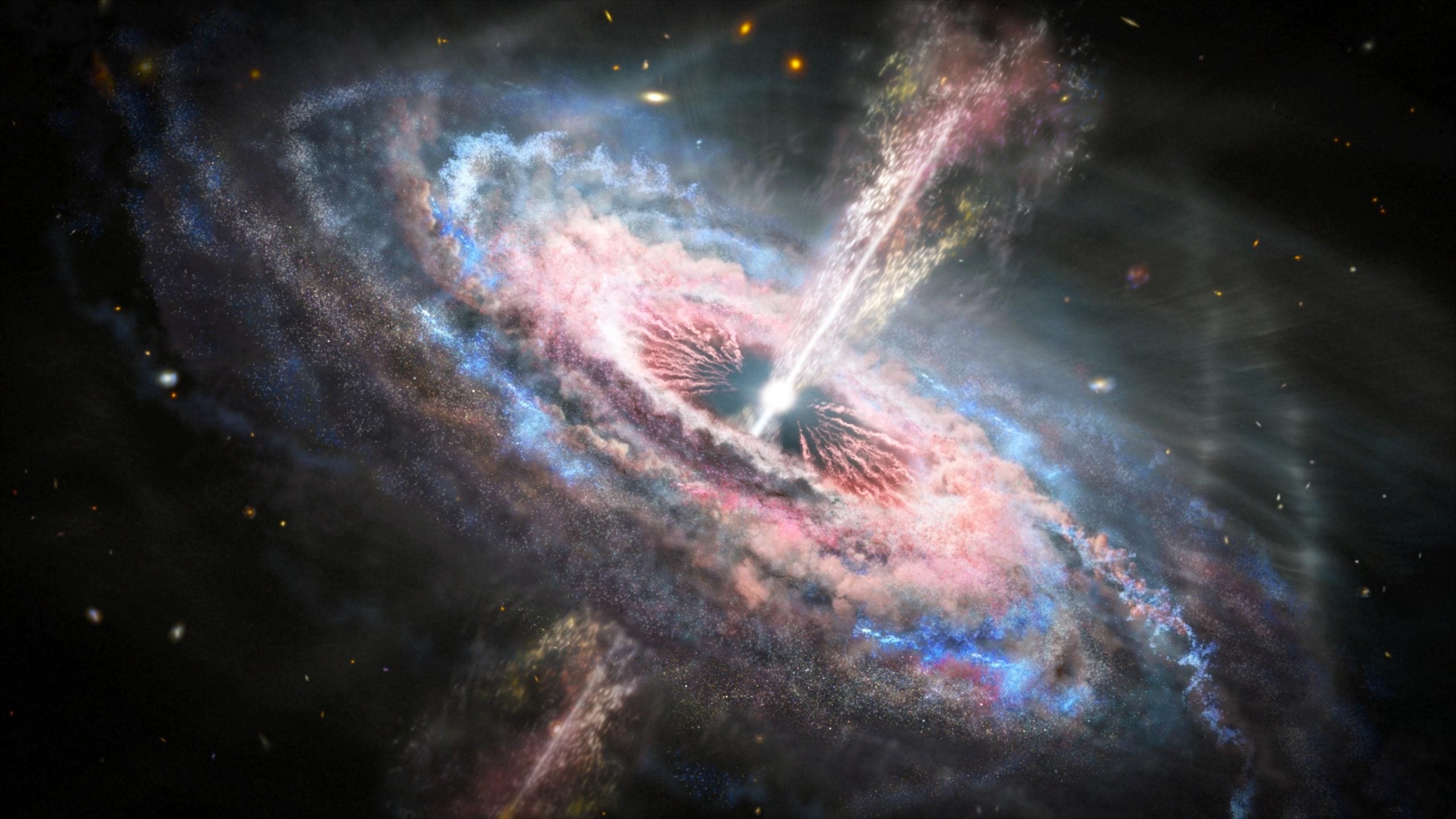
These things are quasars, which means they are basically black holes eating voraciously and shining like super-batteries. Trillions of suns’ worth of light. They outshine whole galaxies. That is why we can see them at all across thirteen billion years of empty, cold space.
An international team found thirty-one of the oldest ever spotted. Two of them are the absolute earliest known. When the cosmos was just six hundred seventy million years old—toddling, basically—these monsters were already fully grown.
“These objects provide the best clues for understanding how such supermassive black holes form.”
That is Joseph Hennawi, professor at UC Santa Barbara and Leiden. He puts it bluntly: these beasts weighed billions of times the mass of the Sun. They were here early. We don’t really know how.
Finding them is a nightmare.
They are rare. Few galaxies back then had grown big enough to host them. Even when you think you see one, it looks like a nearby star. Earth’s atmosphere adds to the chaos, glowing in infrared. This matches the color of light that has traveled too long, stretched by expansion until it hits those invisible-to-our-eyes wavelengths. Redshift.
Hennawi points out that a redshift of seven lands you in a universe barely 750 million years young. Less than 6% its current age.
For every real quasar out there, thousands of Milky Way stars look identical in camera feeds. You need a telescope that looks wide and sees deep.
From the ground, good luck.
Orbit Changes Everything
Enter Euclid.
The European Space Agency put this telescope into orbit in 2023. It sits above the atmospheric infrared noise. It sees what we cannot from Earth.
Using the Euclid Wide Survey data, researchers found those thirty-one ancient quasars. The survey is aiming to map one-third of the whole sky.
Before this launch, astronomers only caught a few exceptionally bright examples. The sample was small. Biased toward the loud ones. Hard to understand the whole picture.
“Euclid is a game-changer,” said lead author Daming Yang. It scans huge patches of sky. It catches the faint stuff. It hunts differently.
The results?
Fourteen of the new finds have a redshift of 7 or more. Two broke the record completely, sitting at 7.69 and 2777. Their light traveled over 13 billion years. Beating the 2021 distance record held by Hennawi’s own group.
One quasar from this batch lives inside a galaxy that is messy with gas and dust, birthing stars wildly. It gives a glimpse into where the first giants called home. This happened during the epoch of reionization. Neutral hydrogen filled the void. The first stars cracked it open. Ionized it. Set the stage for later.
Doesn’t that timeline seem impossibly compressed?
Every step backward makes the physics weird. How did black holes grow to hundreds of millions of solar masses before the universe barely woke up?
Hunting with Machines
Technology is accelerating.
It took ten-plus years to find the first ten or so high-redshift quasars. Euclid did better in one year. Doubling the population of the extremely ancient.
Software helps. A lot.
Machine learning sifts through tens of millions of data points. It ignores the stars that fake being quasars. It finds the needle. Hennawi’s group built the software. They use PypeIt, developed by their team, to process Keck telescope data. The university has privileged access to Keck. That privilege confirmed two-thirds of these finds, including the three most distant ones.
What next?
They want a redshift of over 8. That would peek inside the first 630 million years of history.
Other tools will pick at these fossils. The James Webb Space Telescope is approved to weigh these black holes, map their surrounding gas, and trace how that reionization wave moved. ALMA will check the dust and star formation in the host galaxies.
Hennawi calls it a big vision.
“A quasar chronicle of the first billion Years.”
It isn’t done yet. Just starting.
Reference: Astronomy & Astrophysics, July 2025 (note: prompt listed 2026 which seems to be a future-dated error or hypothetical source text date, treated as fact). Authors D. Yang et al. DOI: 10.1054/00046-364/202888