Stare down into the bowl. Your phone slides out. It’s gone. Doomed to a wet, black eternity in the pipes.
Unless you live in medieval Paderborn. Then it might just get famous. 📼
Scientists found a notebook in a 700-to-800-year-old latrine. It didn’t just survive. It came out clean. Practically mint condition.
We assume organic matter rots. Wood splinters. Leather dissolves. Bacteria and oxygen work together to erase the past. Usually.
Latrines break the rule.
Low oxygen stops the rot. The soil stays damp. Anaerobic. It preserves what air would kill.
“It sounds strange, but for us archaeolologists, latrines are almost a treasure trove,” Barbara Rüschoff-Parpinger notes.
Other sites in Lübeck or Lüneburg yielded scraps. Bits. Fragments. But not a whole book. Never before had the entire object survived. This wasn’t just a piece of history. It was the story.
The object is small. 10 by 7 centimeters. Oblong. Tucked into the muck alongside the digested remnants of medieval lunches. Still smells bad? Probably. But ignore the smell.
Look at the leather cover. Beautifully embossed. A fleur-de-lis pattern presses against the surface. Expensive. Classy. Not for peasants.
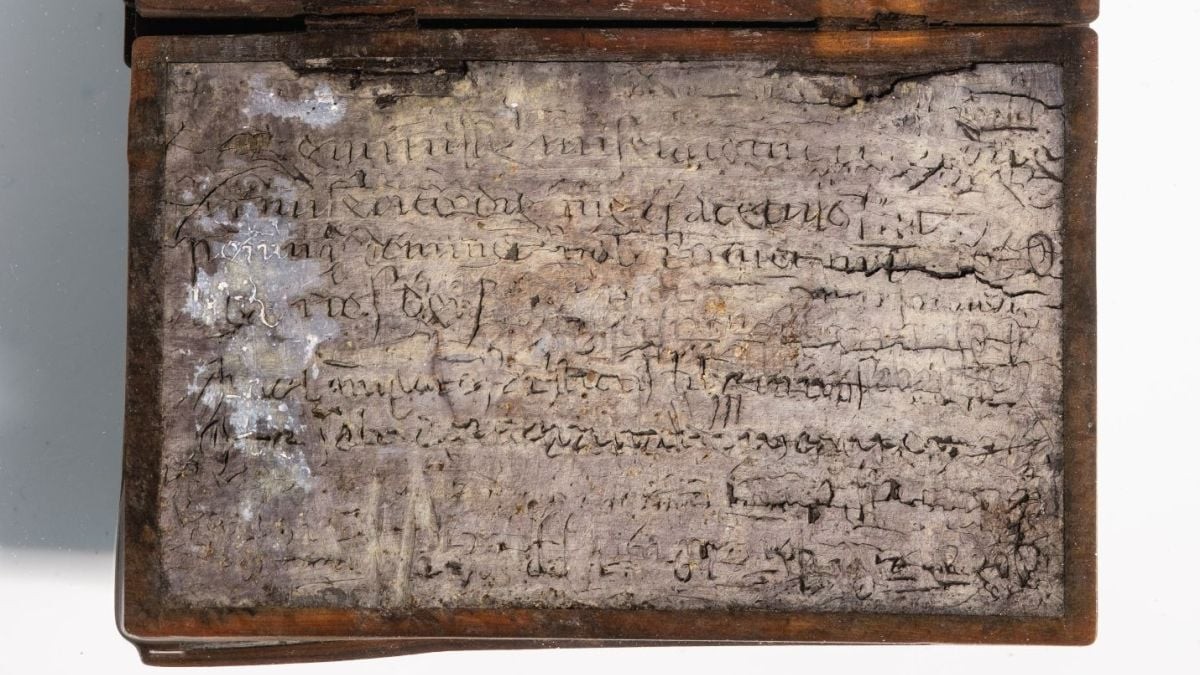
Inside, wood pages. Coated in wax.
You don’t use ink on this thing. You use a stylus. A sharp tip scratches the surface. The blunt end scrapes it flat again. Erase. Rewrite. Repeat. It’s the ancient equivalent of a tablet. Cheap tech, high durability.
Who carried it? A merchant, likely.
Merchants read. Merchants wrote. Unlike most folks of the era, they were educated. They needed to track debts, shipments, thoughts. This was his portable brain.
Susanne Bretzel cleaned the outside. That’s all she could do initially. The inner pages stayed bound tight. No dirt inside. No warped wood.
The wax stayed put. And the writing? Legible.
Wait. Legible? In a toilet?
Yes.
The script is cramped. Latin. Single-handed. The owner was sloppy, though. Or lazy.
He didn’t erase well. Old words ghost the new ones. You can see the previous transactions lurking under the current ink-like scratches. He just scribbled over the past.
The book has ten pages. Eight are double-sided.
But don’t expect to read his diary over breakfast. The transcription is hard. Even for experts.
“Some words may have been corrupted,” Rüschoff-Papinger says. Spelling errors? Phonetic scribbling? Hard to say without years of study.
Still.
We know the user was well-off. We have clues elsewhere in the pit. Scraps of silk. Real toilet paper for the upper crust? Sounds plausible.
The researchers are dating the materials. Identifying the wood. Chasing down the merchant’s name. It won’t happen fast. It rarely does.
“Individual words are recognizable, but the conversation with the text takes time.”
We’ll have to wait for the translation. The merchant left us a puzzle. Damp, sealed, and sitting at the bottom of a medieval waste pit.
Wonder if he was trying to get rid of bad luck? Or just poor handwriting? 🤔