Nature hides its best tricks in weird places.
Meet the green and golden bell frog. Endangered. Common looking. A bit of pattern here and there but nothing special at first glance.
Until it jumps.
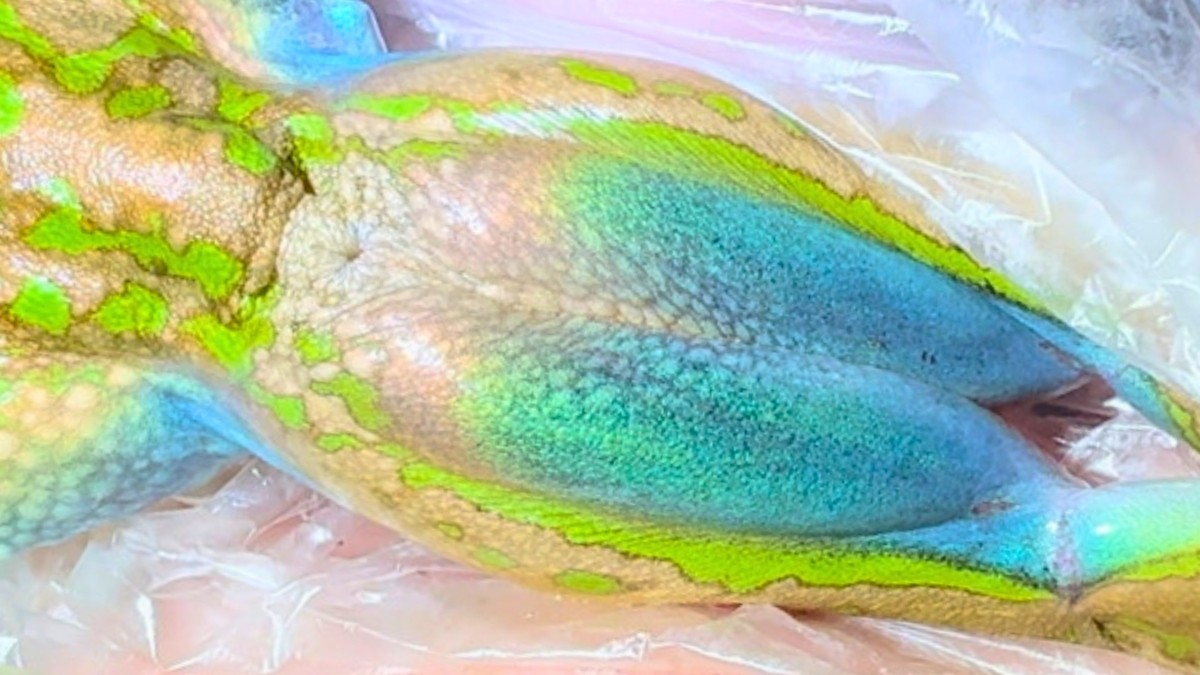
When Ranoida aurea kicks off, its thighs flash blue. Just a split second. You might miss it if you weren’t paying attention. But that isn’t just light playing tricks. It’s true structural iridescence a feature almost never seen in amphibians.
“Iridescence occurs when color changes based on the angle,” John Gould, a conservation biologist at the University of Newcastle says.
Two people watching from different spots see different colors at the same exact time. Wild. And rare.
Here’s the breakdown on color. Usually, it’s chemical. Pigment cells like xanthophores absorb blue light and bounce yellow back. Simple physics. No mirrors involved.
Then there are iridophores. Physical color.
These cells pack tiny crystals. Size matches light waves. They bounce light around create interference. Sometimes the view angle changes the hue.
Most frogs mix these two systems. Their skin is a layered cake of pigment on top of reflectors. Blue reflectors under yellow pigment makes green. Totally standard frog biology.
Or so we thought.
Scientists used to think that blue thigh flash was just noise. Incoherent scattering. Random crystals bouncing blue light everywhere because blue waves are short and scatter easier. The Tyndall effect basically. Blue fog. Not pretty structure. Just chaos.
Gould went to Kooragang Island to mark some frogs. Routine work. Then he noticed something off about the hind legs.
He twisted a thigh. The blue shifted.
Green showed up. Turquoise too. Maybe some warmer tones if the angle was right.
Chaos doesn’t do that.
Random scattering stays random. If colors shift like an opal you need order. Precise alignment. Waves reinforcing or cancelling each other out. Coherent scattering.
“That’s iridescence,” Gould noted.
Think opals. Raindrops on leaves. Insect shells glittering. The frog has that same hardware under the skin.
The discovery leaves more questions than it solves.
If iridophores are everywhere in that skin why is the disco ball effect only on the back legs?
And why do we care?
Gould thinks it’s for survival.
The inner thigh flash scares off predators already. Bright blue pops when a frog runs. Making that pop iridescent? Probably makes it harder for a hawk or snake to track. It grabs attention in a chaotic way. Confuses the enemy.
Most amphibians don’t do this. Only a few species on the books so far.
Maybe we just didn’t look close enough.
A common frog turns out to be hiding a jewel box under its belly. Maybe other creatures are too. The animal kingdom is still full of secrets.