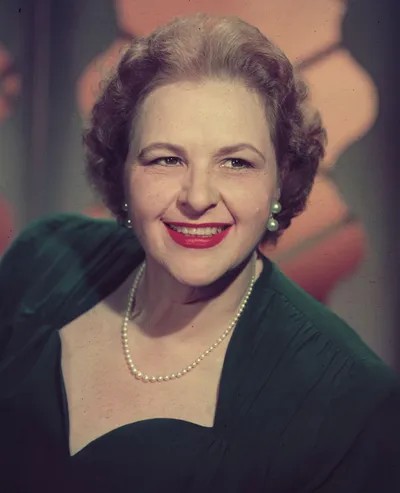
Kate Smith wasn’t just a singer. She was an institution. Born in Greenville, Virginia, on May 1, 1909, she grew up performing before audiences as a child. By age 17, the path was clear. She wasn’t just going to sing. She was going to make a career out of it.
The year was 1926. She headed to New York City with dreams of stardom. She landed a role in the Broadway musical Honeymoon Lane. It seemed like the start of everything. It was the start of a trap.
Smith wanted to sing. The producers wanted a gag. They cast her in comic “fat girl” roles. She hated them. Every single one.
She was wanted mainly for comic “fat girl” roles that she despised.
For years, she bounced between Broadway shows. No singing. Just jokes. Just being the punchline. It was a grind. A long, humiliating grind.
Then came 1930.
A man named Ted Collins walked into her life. He was an executive with Columbia Records. He saw past the typecasting. He saw the voice.
Collins became her manager. He guided her career through the rise of radio. He stayed by her side until his death in 1964.
Smith became known as the “first lady of radio.” It wasn’t just a title. It was a testament to a voice that could fill a living room. From the stage lights of Broadway to the airwaves of America, she reinvented herself.
But that’s just the beginning.
The Voice of a Generation
Collins didn’t just help Kate Smith build Kate Smith Sings on CBS from 1931 to 1947. She helped make it one of the most popular radio programs of the 1930s and early ’40s. On her very first broadcast, Smith chose a tune she had helped write lyrics for: “When the Moon Comes over the Mountain.” It was her theme song.
But the song she is most closely associated with isn’t that one. It’s Irving Berlin’s “God Bless America.”
She introduced it on Armistice Day, 1938. Berlin gave her exclusive rights to sing it on the air for a while. That same year, she added Kate Smith Speaks to her schedule. A daytime radio talk show. By the 1940s, everyone called her the “first lady of radio.”
“This is Kate Smith. Miss Smith is America.”
Franklin D. Roosevelt said that to King George VI of England in 1939. He was introducing her.
Her recordings? Over 2,000. Nineteen of them sold more than a million copies each.
During World War II, she sold more war bonds than anyone else. $600 million worth. She also entertained troops throughout the country with her traveling show.
Beyond the Airwaves
Smith stayed on daytime radio until 1954. The medium was shifting. She moved with it.
From 1950 to 1954, she hosted The Kate Smith Hour on daytime television. It wasn’t just one show. She also starred in The Kate Smith Evening Hour on NBC from 1951 to 1952. Then The Kate Smith Show on CBS in 1960.
She didn’t stop at broadcasting. She made her concert debut at Carnegie Hall in New York City in 1963.
Writing was another outlet. She published two volumes of autobiography. Living in a Great Big Way came out in 1938. Upon My Lips a Song followed in 1960. Then there was the Company’s Coming Cookbook in 1958. Not just stories. Practical things too.
The recognition came late but it was big. In 1982, she was awarded the U.S. Medal of Freedom.
She had been America’s voice for decades. The medal was just one more stamp on a life lived loudly. The radio waves faded. The screens changed. But the name stuck.